
The 6-DOF robot arm — also called a 6-axis robot arm or 6-DOF robotic arm — is the gold standard for articulated automation. With six degrees of freedom, these arms can position an end-effector at any point within their workspace, with any orientation. That makes them indispensable for applications ranging from DIY Arduino projects to high-speed automotive welding and collaborative assembly in modern factories across the USA and Canada.
In 2026, the market for 6-axis robot arms is broader, more affordable, and more connected than ever before. Manufacturers like FANUC, ABB, KUKA, and Universal Robots continue to dominate industrial applications, while open-source designs and desktop collaborative arms from Elephant Robotics, Standard Bots, and DIY Arduino communities bring 6-DOF capabilities to makers, students, and small-scale automation labs.
What Is a 6-DOF Robot Arm?
A 6-DOF robot arm has six independent joints, each contributing one degree of freedom. The first three joints (base rotation, shoulder lift, elbow rotation) typically control the position of the arm's end point (the "wrist center"). The last three joints (wrist pitch, wrist yaw, and wrist roll) control the orientation of the end-effector.
This architecture is standard across industrial robot manufacturers. A 6-axis robot arm from FANUC or ABB operates on the same kinematic principles as a 6-DOF Arduino robot arm — the difference is scale, precision, payload, and control architecture.
The Anatomy of a 6-Axis Robot Arm
Understanding the anatomy of a 6-DOF robot arm is essential whether you are selecting a $30,000 collaborative arm or building a $300 Arduino-based prototype. Each joint is powered by either a servo motor (DIY), a stepper motor (low-cost automation), or a high-torque AC servo with harmonic drive (industrial).
- Joint 1 (Base / Waist): Rotates the arm horizontally around the vertical axis. Typical range: ±180° to ±270°.
- Joint 2 (Shoulder): Controls vertical lift. Typical range: ±90° to ±180°.
- Joint 3 (Elbow): Extends or retracts the forearm. Typical range: ±135°.
- Joint 4 (Wrist Pitch): Tilts the end-effector up or down. Typical range: ±180°.
- Joint 5 (Wrist Yaw): Rotates the end-effector left or right. Typical range: ±270°.
- Joint 6 (Wrist Roll): Rotates the gripper or tool around its own axis. Typical range: ±360° or continuous.
Inverse Kinematics for 6-DOF Robot Arms
Inverse kinematics (IK) is the mathematical process of calculating the joint angles required to reach a desired position and orientation in 3D space. For a 6-DOF robot arm, this is typically solved in two stages: first, solve the first three joints to position the wrist center; second, solve the last three joints to achieve the desired end-effector orientation.
"Inverse kinematics is the bridge between human intent and robot motion. Without it, a 6-axis arm is just a mechanical sculpture."— Dr. Marcus Chen, Lead Robotics Engineer, Standard Bots
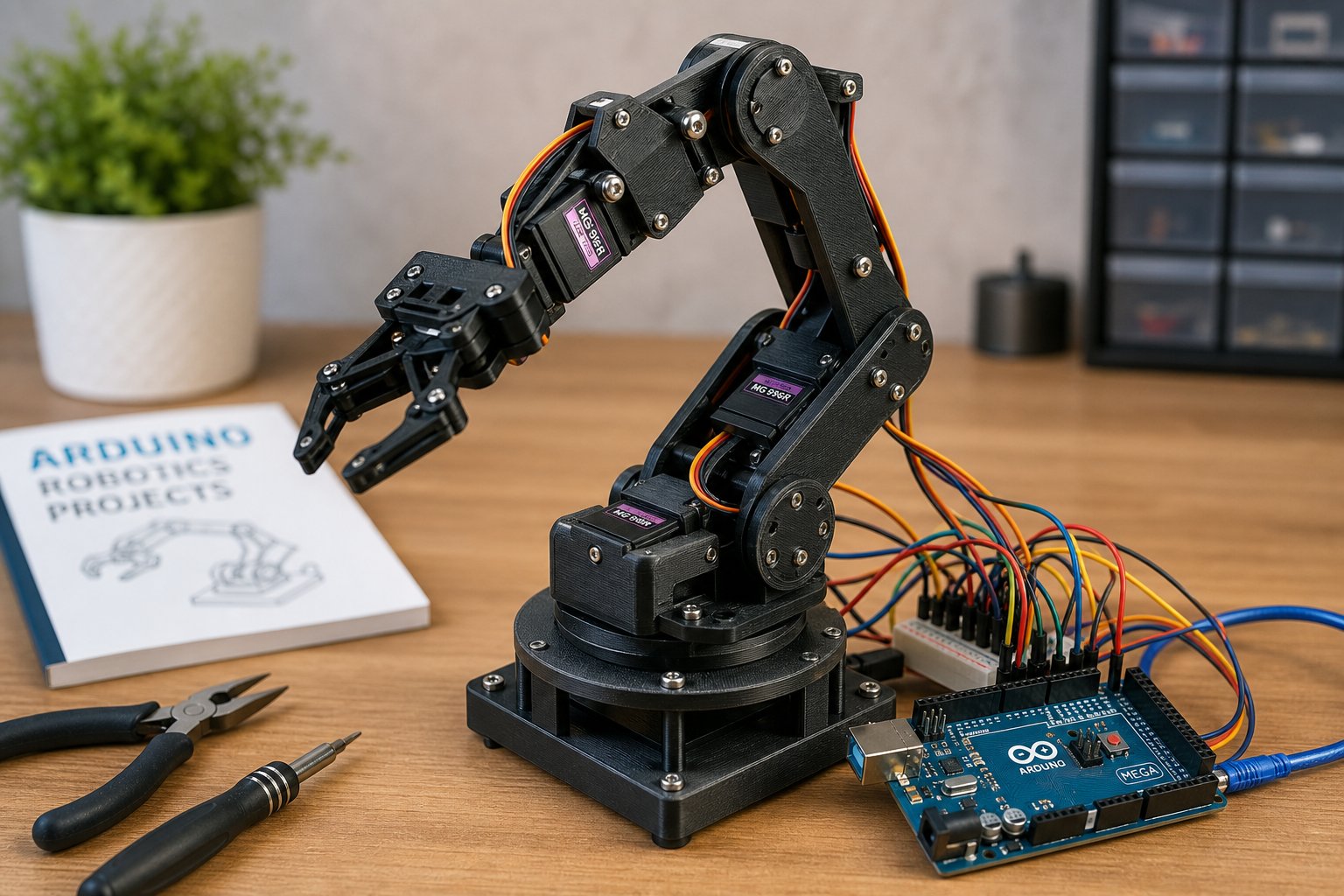
For DIY Arduino robot arms, analytical IK solutions are preferred because they run quickly on microcontrollers like the Arduino Mega or ESP32. Numerical IK (using Jacobian matrices) is more flexible but requires significantly more processing power, making it suitable for ROS 2 systems running on a Raspberry Pi or NVIDIA Jetson.
Arduino Implementation of 6-DOF Inverse Kinematics
A beginner-friendly approach for a 6-DOF Arduino robot arm uses geometric IK for the first three joints and Euler angle decomposition for the last three. The following conceptual steps apply to most open-source designs:
- Compute the base rotation angle using
atan2(y, x)for the target in the XY plane. - Project the target onto the vertical plane (r, z) and solve the elbow angle using the law of cosines.
- Calculate the shoulder angle by subtracting the elbow contribution from the target elevation angle.
- For the wrist, decompose the target rotation matrix into Euler angles (roll, pitch, yaw) and map them to joints 4, 5, and 6.
6-DOF Robot Arm Specifications: DIY vs. Industrial
The specifications of a 6-DOF robot arm vary dramatically between desktop DIY kits and industrial automation systems. Below is a comparison that highlights the differences buyers in the USA and Canada should consider.
| Specification | Desktop DIY (Arduino) | Collaborative (Cobot) | Industrial (FANUC / ABB) |
|---|---|---|---|
| Payload | 0.5 – 1.5 kg | 10 – 20 kg | 20 – 700+ kg |
| Reach | 300 – 700 mm | 900 – 1,750 mm | 1,650 – 3,500 mm |
| Repeatability | ± 1.0 – 3.0 mm | ± 0.03 – 0.1 mm | ± 0.02 – 0.08 mm |
| Speed | 60 – 160°/s (servo) | Up to 1,000 mm/s TCP | 5 – 10 m/s (max TCP) |
| Controller | Arduino Mega / ESP32 | Built-in / Teach Pendant | Dedicated robot controller |
| Safety | User-managed | ISO 10218 / ISO/TS 15066 | ANSI / CSA / ISO compliant |
| Approx. Price | $250 – $2,500 | $25,000 – $60,000 | $35,000 – $150,000+ |
Top Manufacturers of 6-Axis Robot Arms in 2026
For buyers in North America, the choice of manufacturer affects not only performance but also service network availability, spare parts delivery times, and regulatory compliance. The following manufacturers represent the top tier for 6-DOF robot arms in 2026.
FANUC
FANUC remains the global leader in industrial robot installations. Its 6-axis LR Mate and M-20 series are particularly popular in the USA and Canada for electronics assembly, pick-and-place, and high-speed material handling. FANUC arms offer exceptional reliability, rapid cycle times, and deep service networks across North America.
ABB Robotics
ABB's IRB 2600 and IRB 4600 series provide a balance of high payload, precision, and flexibility. The company is particularly strong in automotive welding and material handling applications. ABB's RobotStudio software allows offline programming, which reduces downtime and improves deployment speed.
KUKA
KUKA's 6-axis KR series is engineered for heavy-duty automation, especially in automotive manufacturing. The KR C5 controller introduces smart factory integration features that make it a premium choice for large-scale automation projects. KUKA also offers collaborative robot arms through its LBR iisy series, expanding its presence in the USA and Canada.
Universal Robots
Universal Robots (UR) leads the collaborative robot market. Its UR20 and UR30e 6-axis arms offer payloads up to 20 kg and 30 kg respectively, with built-in force and torque sensors that enable safe human-robot collaboration without extensive safety guarding. This makes them a premium choice for small and medium manufacturers in Canada and the USA.
Standard Bots
Standard Bots has emerged as a competitive American manufacturer of collaborative robot arms. Its RO1 and RO2 series combine a lower price point with American-based support and faster lead times for USA buyers. The company is particularly attractive for startups and small-scale automation labs looking for 6-DOF capabilities without industrial-scale budgets.
6-DOF Robot Arm Price Guide for 2026
The price of a 6-DOF robot arm depends heavily on payload, reach, brand reputation, control architecture, and included software. Below is a premium buyer's guide to approximate pricing for the North American market in 2026.
| Model / Brand | Type | Payload | Reach | Approx. Price (USD) | Best For |
|---|---|---|---|---|---|
| FANUC LR Mate 200iD | 6-Axis Industrial | 7 kg | 717 mm | $42,000 | High-speed assembly, electronics |
| ABB IRB 2600 | 6-Axis Industrial | 20 kg | 1,650 mm | $68,000 | Material handling, welding |
| KUKA KR 20 R1810 | 6-Axis Industrial | 20 kg | 1,810 mm | $75,000 | Automotive, heavy assembly |
| Universal Robots UR20 | Collaborative (Cobot) | 20 kg | 1,750 mm | $55,000 | Flexible manufacturing, SMEs |
| Standard Bots RO1 | Collaborative (Cobot) | 18 kg | 1,300 mm | $29,000 | Startups, light automation |
| Elephant Robotics myCobot 320 M5 | Desktop 6-DOF | 1 kg | 350 mm | $3,500 | Education, research, prototyping |
| XYZrobot 6-DOF Kit | DIY / Arduino | 0.7 kg | 400 mm | $350 | Hobbyists, students, makers |
Applications of 6-DOF Robot Arms
The versatility of a 6-axis robot arm makes it suitable for a vast range of applications. Below are the highest-value applications for buyers in the USA and Canada, along with the robot arm specifications most relevant to each use case.
Industrial Automation and Assembly
For high-volume manufacturing, 6-axis robot arms are used for assembly, pick-and-place, screw driving, and quality inspection. The key specifications are payload (typically 5 – 20 kg), repeatability (±0.05 mm or better), and cycle time. FANUC and ABB dominate this space with proven reliability and fast service networks.
Welding and Material Handling
Welding applications require a robot arm with a payload of at least 10 kg, a reach of 1,500 mm or more, and high precision. KUKA's KR series and ABB's IRB series are specifically engineered for arc welding and spot welding. Safety and fume extraction are critical considerations for buyers in the USA and Canada.
Collaborative Assembly
Collaborative robot arms allow humans and robots to work in shared spaces. These applications prioritize safety ratings (ISO 10218, ISO/TS 15066), ease of programming, and flexibility. Universal Robots and Standard Bots lead this market with intuitive teach-pendant interfaces and rapid redeployment capabilities.
Medical and Surgical Robotics
In medical applications, 6-axis robot arms are used for surgical assistance, lab automation, and prosthetic testing. These applications require extremely high repeatability (±0.02 mm or better), cleanroom compatibility, and strict regulatory compliance. Specialized manufacturers like KUKA (LBR Med series) and smaller research-grade arms serve this market.
Buyer's Checklist for 6-DOF Robot Arms
Before purchasing a 6-axis robot arm in 2026, evaluate the following criteria in order of priority. This checklist is designed for premium buyers in the USA and Canada who value long-term reliability over the lowest initial price.
- Payload and Reach: Confirm the arm can handle your heaviest part at full extension with adequate safety margin.
- Repeatability and Accuracy: Look for ±0.05 mm or better for assembly; ±0.02 mm for precision applications.
- Control Architecture: Evaluate whether the controller supports your programming environment (Arduino, ROS 2, proprietary).
- Safety and Compliance: Verify ANSI, CSA, or ISO compliance based on your location and application.
- Service Network: Confirm certified service support near your facility in the USA or Canada.
- Software and Integration: Assess programming complexity, simulation capabilities, and compatibility with existing automation systems.
- Total Cost of Ownership: Model installation, tooling, maintenance, training, and downtime over a 5-year horizon.
Frequently Asked Questions
What does 6-DOF mean for a robot arm?
6-DOF stands for six degrees of freedom — the number of independent joint movements an arm can make. A 6-axis robot arm can position any object within its workspace and orient it in any direction, making it the most versatile articulated robot design.
How much does a 6-DOF robot arm cost in 2026?
Prices range from approximately $350 for a DIY Arduino kit (XYZrobot 6-DOF) to $150,000+ for large industrial 6-axis arms with high payload and extended reach. Collaborative robot arms from Universal Robots typically fall between $25,000 and $60,000.
Can I build a 6-DOF robot arm with Arduino?
Yes. Multiple open-source designs and commercial kits (like the XYZrobot 6-DOF Arm Kit) use Arduino-compatible controllers, smart servos, and 3D-printed structural components. These builds are ideal for education, prototyping, and light automation tasks with payloads under 1.5 kg.
What is inverse kinematics for a 6-axis robot arm?
Inverse kinematics is the mathematical process of calculating the joint angles required to reach a specific 3D position and orientation. For 6-axis robot arms, this is usually solved in two stages: first for the first three joints (position), then for the last three joints (orientation).
Are 6-axis robot arms safe for collaborative work?
Only collaborative robot arms (cobots) with certified force and torque limits are designed for safe human collaboration. Traditional industrial 6-axis robot arms require safety guarding, light curtains, and interlocked access doors according to ANSI/RIA R15.06 (USA) and CSA Z434 (Canada) standards.
Conclusion
The 6-DOF robot arm remains the backbone of modern automation in 2026. Whether you are a maker building an Arduino-based 6-axis prototype, a small manufacturer evaluating collaborative robot arms, or a large industrial buyer selecting FANUC or ABB systems, the principles of kinematics, payload, and total cost of ownership remain universal.
For buyers in the USA and Canada, the key to a premium purchase is not just comparing sticker prices — it is evaluating service networks, software integration, safety compliance, and long-term reliability. The manufacturers and products featured in this guide represent the upper tier of engineering quality and market availability for 6-axis robot arms in the North American market.
For more tutorials, hardware reviews, and robot arm comparisons, explore the Robotics Engineering Blog.