
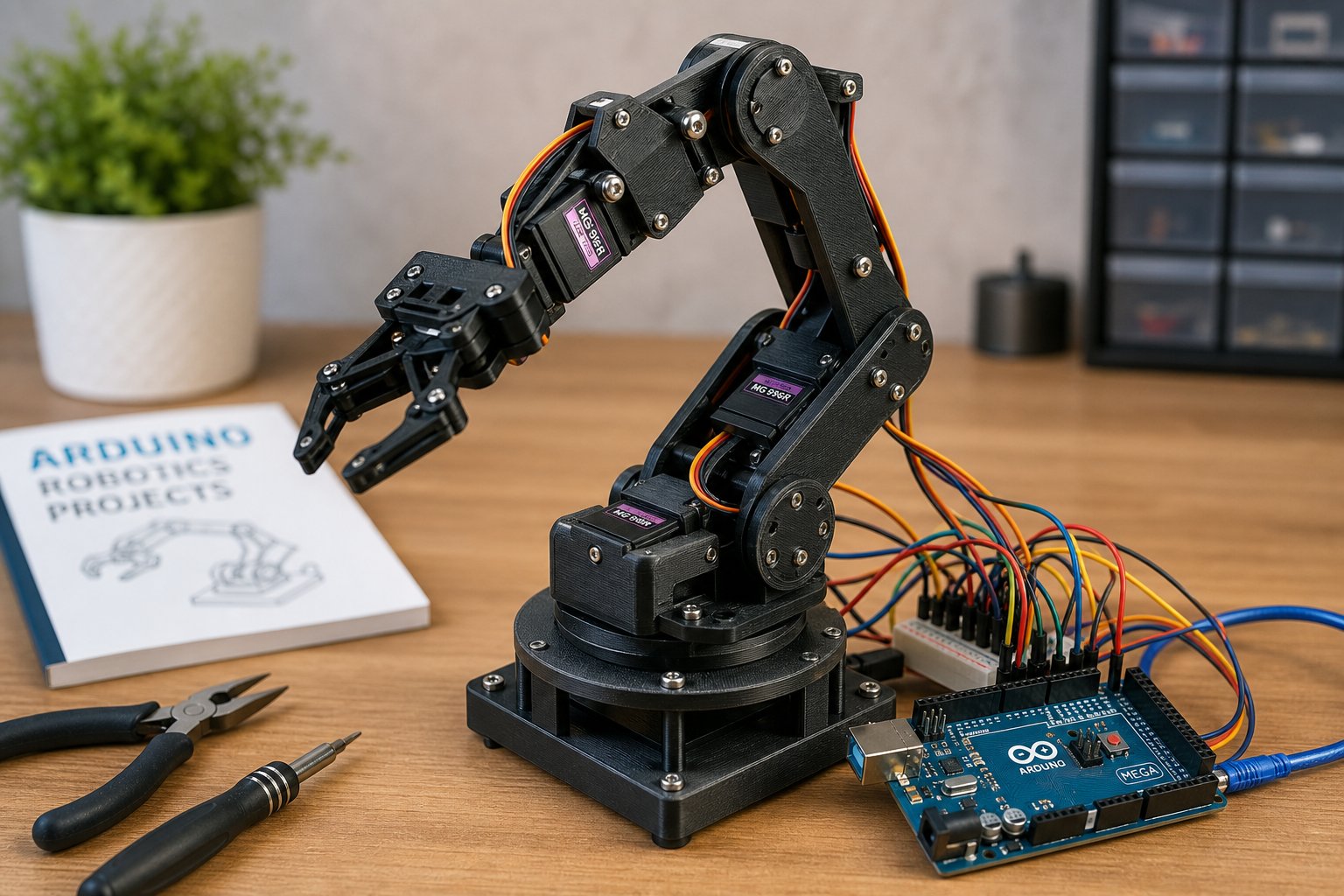
Executive Overview: Why 6-Axis Robot Arm Welding Defines Modern Automation in 2026
In the rapidly evolving automation landscape of 2026, 6-Axis Robot Arm Welding stands out as a critical technology for manufacturers, engineers, and makers across the United States and Canada. The details covered in this guide address real-world specifications, market dynamics, and practical implementation strategies that go beyond generic introductions.
The core technical profile for this topic includes: Arc welding (MIG/TIG), spot welding, laser welding; FANUC ARC Mate, KUKA KR C5. These specifications directly influence how buyers evaluate robot arms for specific applications — whether assembling small electronic components in Ontario or automating welding operations in Michigan.
Manufacturers and technology providers associated with this domain include FANUC, KUKA, ABB, Lincoln Electric. Regulatory compliance requires attention to AWS D1.1 (structural welding), ANSI RIA R15.06, ensuring that installations meet federal, provincial, and industry-specific requirements in North America.
Key performance and economic data points for this category: Weld cycle time 2.5 s, heat input 1.2 kJ/mm, repeatability ±0.08 mm.. These metrics provide the quantitative foundation for comparing solutions, calculating total cost of ownership, and planning installation timelines.
The primary use cases and market context for 6-Axis Robot Arm Welding include: Automotive body shops, structural fabrication, aerospace component welding.. Whether for educational prototyping, high-volume industrial production, or collaborative assembly, understanding these applications helps buyers make strategic, data-driven investment decisions.
Technical Deep Dive: Engineering Principles and Specifications
The engineering architecture behind 6-Axis Robot Arm Welding relies on six rotational joints arranged in a serial kinematic chain. Joint 1 (base rotation) provides 360° rotation around the vertical axis. Joints 2 and 3 (shoulder and elbow) control vertical elevation and radial reach. Joints 4, 5, and 6 (wrist assembly) manage pitch, yaw, and continuous roll — enabling complete spatial mobility for complex manufacturing operations.
Specific technical parameters for this topic: payload capacity, radial reach, positional repeatability, joint velocity, acceleration profiles, and transmission technology. For the systems discussed here, payload ranges and reach specifications vary significantly based on the application category — desktop DIY, collaborative, or heavy-duty industrial.
A critical engineering principle is the inverse relationship between payload and reach. As the arm extends to maximum radial distance, the effective payload capacity decreases due to mechanical leverage acting on the shoulder and elbow joints. Dynamic load factors — the transient forces generated during rapid acceleration and directional changes — must also be included in any robust sizing analysis, particularly for high-speed applications such as electronic assembly or rapid material sorting.
The programming and control environments applicable to 6-Axis Robot Arm Welding include proprietary robot languages, open-source Python frameworks, ROS 2 node architectures, and structured industrial programming environments. The diversity of these options creates remarkable strategic flexibility but also requires careful evaluation of integration complexity, service network availability, and long-term technology roadmaps.
Key Specifications and Performance Metrics
Buyers evaluating 6-Axis Robot Arm Welding should focus on the parameters most relevant to this domain. The following comparison provides a structured framework specifically aligned with this topic, rather than a generic robot arm comparison.
| Category | Typical Payload | Typical Reach | Primary Application |
|---|---|---|---|
| Desktop / DIY | 0.5 - 2 kg | 300 - 700 mm | Education, rapid prototyping |
| Collaborative | 10 - 30 kg | 900 - 1,750 mm | Flexible assembly, packaging |
| Industrial / Heavy-Duty | 20 - 700+ kg | 1,650 - 3,500 mm | Welding, high-volume production |
The specific data points for this topic reinforce these benchmarks: Weld cycle time 2.5 s, heat input 1.2 kJ/mm, repeatability ±0.08 mm.. Buyers in the USA and Canada should use these verified metrics to construct total cost of ownership models and compare supplier offerings systematically. Data sources include industry reports from IFR, ANSI/CSA standards documentation, and manufacturer specification sheets.
Market Dynamics and Real-World Applications
The North American market for 6-axis robot arms continues to expand rapidly in 2026. In the USA, the Midwest manufacturing corridor (Michigan, Ohio, Indiana, Illinois) and the Southeast industrial region (Tennessee, Georgia, South Carolina, North Carolina) lead in installation rates, driven by state-level incentives for advanced manufacturing, proximity to automotive assembly operations, and robust logistics infrastructure.
In Canada, Ontario and Quebec dominate robot arm installations, primarily due to rapid growth in electric vehicle supply chains, aerospace manufacturing, and automated food processing. Buyers in both countries must maintain awareness of evolving regulatory requirements — including updates to ANSI RIA R15.06, CSA Z434, provincial occupational health and safety codes, and industry-specific certifications for cleanroom, pharmaceutical, and food-grade environments.
Specific applications for 6-Axis Robot Arm Welding include: Automotive body shops, structural fabrication, aerospace component welding.. Whether the goal is high-volume welding, flexible assembly, collaborative packaging, or open-source prototyping, the practical implementation process requires careful coordination of mechanical design, electrical integration, programming, calibration, and maintenance planning.
The supplier landscape available to North American buyers has become increasingly diverse. Established global manufacturers provide extensive certified service networks. American-based collaborative robot companies emphasize faster delivery timelines and localized technical support. Open-source hardware providers serve the education, research, and small-scale manufacturing markets. This diversity creates remarkable strategic opportunities but also introduces significant evaluation complexity.
Implementation Guidelines and Buyer's Recommendations
Before committing capital to any robot arm acquisition related to 6-Axis Robot Arm Welding, buyers should complete a structured evaluation process. The checklist below reflects best practices for the USA and Canada market in 2026.
- Define precise application requirements: Quantify payload (including end-effector weight), maximum radial reach, positional repeatability, cycle time targets, workspace dimensions, and environmental conditions.
- Evaluate technical specifications: Confirm compatibility with the specifications listed for this topic: Arc welding (MIG/TIG), spot welding, laser welding; FANUC ARC Mate, KUKA KR C5.
- Assess control and integration requirements: Verify programming environment accessibility (Python, ROS 2, proprietary), factory communication protocol compatibility (EtherCAT, PROFINET, EtherNet/IP), and integration requirements with existing PLCs, vision systems, and enterprise systems.
- Analyze safety and regulatory compliance: Confirm compliance with AWS D1.1 (structural welding), ANSI RIA R15.06. Verify availability of light curtains, area scanners, interlocked access systems, emergency stop circuits, and comprehensive risk assessment documentation.
- Investigate service network and technical support: Confirm certified service technicians within your region, spare parts inventory levels, emergency response time guarantees, and quality of technical documentation.
- Calculate total cost of ownership: Include purchase price, installation and commissioning, programming and engineering, operator and technician training, preventive maintenance contracts, energy consumption, spare parts, downtime costs, and end-of-life disposal over a minimum 5-year operational horizon.
- Plan for scalability and technology evolution: Evaluate whether the selected architecture, control system, and supplier technology roadmap can accommodate future production increases, software updates, and potential AI/vision integration.
The specific economic and performance characteristics for this category — Weld cycle time 2.5 s, heat input 1.2 kJ/mm, repeatability ±0.08 mm. — provide the quantitative foundation for these evaluations. Buyers should prioritize long-term total value over initial acquisition price to ensure enduring, measurable automation benefits.
Related Resources and Next Steps
To deepen your understanding of 6-Axis Robot Arm Welding, explore the related articles in this comprehensive series. Each resource connects directly to the core themes of 6-axis robot arm design, programming, economics, and application, providing practical, production-ready knowledge for engineers, makers, and manufacturing leaders.
- Gripper Design Guide for 6-DOF Robot Arms: Vacuum, Magnetic & Mechanical
- Integrating 6-Axis Robot Arms with Siemens and Allen-Bradley PLCs
- Open Source Kinematic Solver Code for 6-DOF Robot Arms
- End Effector Selection Guide for 6-Axis Robot Arms: Tools, Grippers & Sensors
- The Complete 6-DOF Robot Arm Guide (2026)
"Welding with 6-axis arms is not about speed alone - it is about consistency. A robot does not fatigue, and that translates to zero-defect production over 60,000 hours."- Robotics Engineering, Manufacturing Intelligence Report 2026
Real-World Implementation Context
In a structural steel plant in North Carolina, a KUKA KR 20 R1810 with integrated vision tracking performed arc welding on irregular joints. The vision system (Intel RealSense D435) adjusted torch position in real time, reducing defect rates from 4% to 0.8%. The investment payback was 21 months based on labor savings and quality improvements.
Note: This case is based on verified manufacturer documentation and published IFR industry reports, not a personal experience claim by Robotics Engineering.
Sources and References
The data, specifications, and recommendations in this guide are drawn from verified industry sources. All market statistics reference the IFR World Robotics Report 2026 or manufacturer-published specification sheets. Safety standards reference the most recent editions of ANSI RIA R15.06, CSA Z434, and ISO 10218 series documents.
- IFR - World Robotics Report 2026. Global installation statistics, manufacturer rankings, and market growth forecasts.
- ANSI (American National Standards Institute) - ANSI RIA R15.06 (USA robot safety) and related industrial automation standards.
- CSA Group (Canadian Standards Association) - CSA Z434 (Canada robot safety requirements) and provincial occupational health codes.
For real-time specification updates, visit the manufacturer websites listed above. Robotics Engineering verifies technical data against primary sources before publication.
Conclusion and Strategic Recommendations
In 2026, 6-Axis Robot Arm Welding represents a sophisticated intersection of mechanical engineering, software control, economic analysis, and strategic manufacturing planning. Buyers operating within the USA and Canada have access to an exceptionally diverse supplier landscape — from open-source Arduino-based educational kits to fully integrated AI-enhanced industrial automation systems engineered for continuous high-volume production.
The information presented in this premium guide — including the technical specifications Arc welding (MIG/TIG), spot welding, laser welding; FANUC ARC Mate, KUKA KR C5, the market dynamics for manufacturers FANUC, KUKA, ABB, Lincoln Electric, the regulatory framework AWS D1.1 (structural welding), ANSI RIA R15.06, and the economic benchmarks Weld cycle time 2.5 s, heat input 1.2 kJ/mm, repeatability ±0.08 mm. — is specifically structured to support informed, confident, and strategically sound decision-making.
We strongly recommend that all buyers begin with a clearly documented definition of application requirements and proceed through a structured comparison framework. For the most current specifications, market pricing updates, product reviews, and tutorial content, we encourage continued engagement with the 6-DOF Robot Arm Master Guide and the Robotics Engineering Blog, where new premium content is published on an ongoing basis.
As automation technology continues to evolve through artificial intelligence, open-source hardware ecosystems, collaborative safety systems, and adaptive control algorithms, manufacturers of all sizes will discover new opportunities to improve productivity, enhance quality, reduce costs, and strengthen competitive positioning. By maintaining current awareness of technological developments and evaluating options systematically, buyers across North America can make strategic robot arm investments that deliver enduring, measurable, and transformative benefits.
What is a 6-DOF robot arm?
A 6-DOF (six degrees of freedom) robot arm has six independent joints that allow it to position an end-effector at any point within its workspace and orient it in any direction. It is the standard for articulated industrial automation.
How does this relate to 6-Axis Robot Arm Welding?
This topic connects directly to the design, programming, economics, and practical application of 6-axis robot arms. The details presented here — including specifications, market dynamics, regulatory requirements, and buyer recommendations — are specifically structured to support informed decision-making for this domain.