
Editorial Disclosure & Technical Scope
This article is a specification-based comparison. Robotics Engineering Lab does not own, operate, or bench-test cobot or industrial arms; every specification, price range, and safety statement below is compiled from official manufacturer documentation, distributor listings, and standards bodies (ISO, ANSI/RIA, CSA, OSHA), each cited in the sources section with an access date. Safety guidance here is educational and does not approve, certify, or validate any robot cell. Always have the risk assessment and safeguarding design reviewed by a qualified system integrator, controls engineer, or safety professional, and consult the current edition of the applicable standard.
What the Two Classes Actually Are
The phrase cobot vs industrial robot arm describes a real purchasing decision, but the two categories are not symmetric. An industrial robot arm is a multi-axis manipulator designed for guarded, high-speed, high-payload operation in a defined, safeguarded workspace. A collaborative robot arm (cobot) is also an articulated manipulator, but its controller implements one or more of the collaborative operating modes defined in ISO 10218-1 and ISO/TS 15066: safety-rated monitored stop, hand guiding, speed and separation monitoring (SSM), and power and force limiting (PFL).
The distinction that matters for engineering decisions is that collaborative operation is a property of the application, not a property of the arm. A cobot running at full speed with a sharp end effector and no safeguards is not collaborative. Conversely, a guarded industrial arm with a safety-rated monitored stop can participate in a collaborative application in limited ways. That framing comes directly from the standards: ISO 10218-1:2025 covers the robot itself, while ISO 10218-2:2025 covers the robot application and cell, where the actual safety concept is defined.
This guide walks through the differences that change procurement decisions in North American plants and laboratories: payload and reach, cycle speed, precision, safety architecture, programming and changeover, and total cost. The decision matrix in Section 5 is the deliverable to take to a purchase meeting.
The Five Engineering Differences That Decide the Choice
Most applications are decided by a handful of measurable properties. Work through them in this order before looking at price.
1. Payload and Reach
Collaborative arms are typically offered with payloads from 3 kg to 25 kg, with a few heavy-duty models reaching 30 kg or more. Industrial articulated arms start around 3 kg and scale to 100 kg, 500 kg, and beyond 1,000 kg for automotive body-in-white and heavy material handling. Reach follows the same pattern: most cobots span roughly 500 mm to 1,300 mm, while industrial arms reach 2,000 mm to 4,000 mm in the larger classes. If the workpiece plus end effector exceeds the cobot payload envelope at the required wrist moment, the decision is made before any other criterion.
Payload must be evaluated at the actual wrist moment and reach, not just the nameplate value. A cobot rated for 10 kg at a centered load may be derated to 5 kg when the gripper offsets the center of gravity by 200 mm. Our robot arm payload and wrist moment calculator applies the same derating logic to any arm class.
2. Cycle Speed and Throughput
Full-speed industrial arms reach TCP velocities of several meters per second and joint speeds that support cycles under two seconds in light applications. Collaborative arms in PFL mode operate at speeds constrained by the force and pressure limits in ISO/TS 15066, so effective TCP speeds of 0.25–1.0 m/s are typical in shared-space operation. SSM improves throughput by allowing full speed when the protected zone is empty, but the zone, the detection time, and the stopping distance all come out of the cycle budget. Rule of thumb used across integrator guides: sustained throughput above roughly 8–12 cycles per minute with continuous operation favors a guarded industrial arm, while low- to mid-volume, high-mix production fits a cobot.
3. Repeatability and Path Accuracy
Typical published repeatability values are ±0.02 to ±0.05 mm for industrial arms and ±0.02 to ±0.1 mm for cobots in the same size class. For most assembly, tending, and packaging tasks, both classes are adequate. The gap shows up in high-precision work such as optical alignment, electronics insertion, and dispensing, where the tighter industrial specification and stiffer transmissions matter. Remember that repeatability is not accuracy: both classes need TCP calibration and kinematic verification before precision claims apply.
4. Safety Architecture and Guarding
This is the difference with the largest cost and floor-space consequences. A full-speed industrial arm operates inside a safeguarded space: perimeter fencing, interlocked gates, light curtains or area scanners, and a safety-rated control system typically achieving PL d or PL e per ISO 13849-1. A cobot application may run without fixed guarding only if the risk assessment shows that the contact scenarios stay within the force and pressure limits of ISO/TS 15066 for every relevant body region, considering the end effector, workpiece, and any pinch points. That assessment is not optional paperwork; it is the engineering artifact that defines the cell. See our risk assessment guide for the method, and the USA/Canada standards overview for how ANSI/RIA R15.06, CSA Z434, and ISO 10218 interact.
5. Programming and Changeover
Cobots are sold on programming speed: drag-to-teach, guided path recording, and graphical block programming put a first program in front of an operator in hours. Industrial arms typically use vendor languages (FANUC TP, KUKA KRL, ABB RAPID) and offline programming tools, and a first program from an experienced programmer commonly takes one to five days including validation. Changeover follows the same pattern: hours for a cobot redeployed to a new fixture, days for an industrial arm with a new tool and program. If the line changes tasks more than once a quarter, that difference dominates the cost comparison.
Illustrative scenario — not a report of a Robotics Engineering Lab test
A small machine shop loads one CNC lathe with 2 kg aluminum blanks, changes the part program three times per week, and has no room for a fenced cell. The payload is inside the cobot envelope, throughput is under 8 parts per minute, and the operator works beside the arm. Under those constraints, a collaborative arm with a task-based risk assessment is the defensible engineering answer. The same shop planning a 24-hour, 15-parts-per-minute line for one high-volume part, with the arm inside a fence, should price a compact industrial arm instead.
Safety Architecture: Fencing, PLr, and Power and Force Limiting
The safety concept is where the two classes genuinely diverge, and it is worth understanding the mechanism rather than the marketing. For a guarded industrial application, the safeguarding performance level (PLr) is determined by the risk assessment. The robot's safety functions — emergency stop, protective stop, safety-rated monitored stop, SSM — must be implemented in safety-related parts of the control system (SRP/CS) rated to that PLr, with dual-channel architecture where required. Physical guarding per ISO 10218-2 and ANSI/RIA R15.06 keeps people out of the hazard zone while the arm runs at full speed.
For a collaborative application, the limits are biomechanical. ISO/TS 15066:2016 publishes quasi-static and transient force and pressure limits by body region (for example, 130 N quasi-static force for the skull/forehead region and 65 N for the face, with pressure limits expressed in N/cm2). PFL validation measures the arm, the tooling, and the workpiece together at the relevant speeds and contact geometries. The 2025 ISO 10218 editions fold collaborative requirements into Parts 1 and 2 and introduce Class I and Class II robot categories tied to functional safety requirements, which is why a cobot purchased for a 2026 project should be specified and documented against ISO 10218-1:2025.
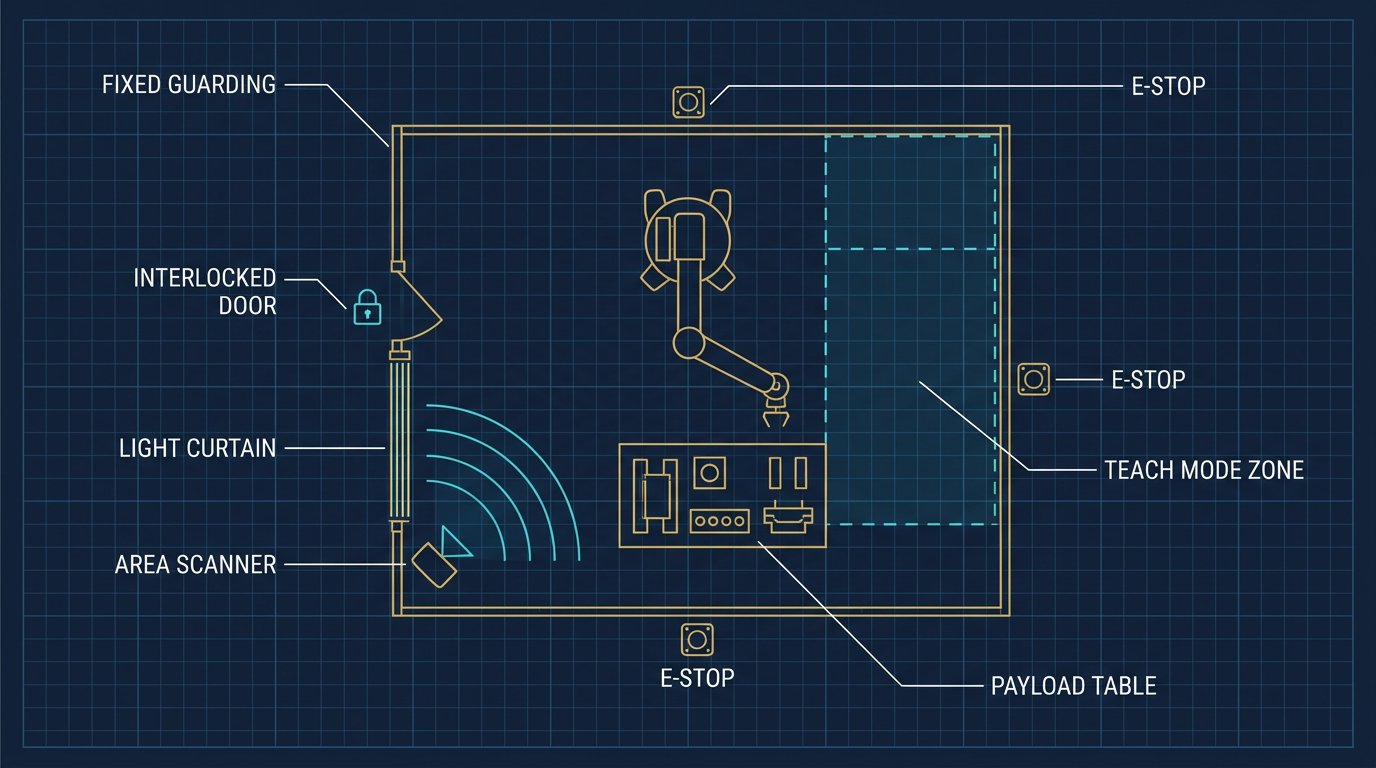
Do not assume a cobot means no guarding. A cobot with a heavy gripper, a rotating spindle, or a sharp blade frequently fails the force and pressure limits in the assessment, and the resulting design uses a light curtain, a fence, or a safety-rated monitored stop anyway. The honest way to read the comparison: a cobot buys the option of shared-space operation; the risk assessment decides whether that option is usable.
Cobot vs Industrial Robot Arm: Side-by-Side Specification Table
| Property | Collaborative robot arm (cobot) | Industrial robot arm |
|---|---|---|
| Typical payload | 3–25 kg (heavy-duty models to ~35 kg) | 3–2,300 kg across classes |
| Typical reach | 500–1,300 mm | 600–4,000 mm across classes |
| Max TCP speed | Collaborative mode limited by force/pressure limits; SSM can restore full speed in an empty zone | Up to 10 m/s or more inside guarding |
| Repeatability | ±0.02 to ±0.1 mm (typical published) | ±0.01 to ±0.05 mm (typical published) |
| Safety approach | Collaborative modes per ISO 10218-1/ISO/TS 15066, decided by risk assessment | Safeguarded space: fencing, interlocks, ESPE, PLr-rated SRP/CS |
| Guarding required | Only if risk assessment requires it | Yes, for full-speed operation |
| First program | Hours (drag-to-teach, graphical blocks) | 1–5 days (vendor languages, offline tools) |
| Changeover | 30 minutes to 2 hours typical | Hours to days including validation |
| Arm-only CapEx (indicative 2026) | Roughly USD 8,000–65,000 depending on payload and brand | Roughly USD 25,000–400,000+ depending on payload class |
| Typical full cell | USD 40,000–120,000 including tooling and integration | USD 60,000–250,000+ with guarding, tooling, integration |
| Duty and environment | Designed for flexible, human-adjacent tasks; IP ratings vary by model | Engineered for 24/7 duty in harsh environments with options like IP67, cleanroom, foundry |
Sources for the ranges in this table are the manufacturer and distributor listings and integrator comparison guides listed in Sources and Methodology; they are directional 2026 planning ranges, not quotes.
Decision Matrix: Score Your Application
Use this scored matrix instead of a gut feeling. For each criterion, assign the application a score of 0–2 for the arm class that handles it better (0 = poor fit, 2 = clear fit), then sum. The class with the higher total is the starting point; the total does not override safety or payload hard limits.
| Decision criterion | Ask this question | Cobot scores 2 when… | Industrial scores 2 when… |
|---|---|---|---|
| Payload | Does part + gripper fit the class envelope at the needed wrist moment? | Part + tooling ≤ 10 kg, centered | Part + tooling > 25 kg or long-reach heavy loads |
| Throughput | What sustained cycle is required? | Under ~8–12 cycles/min or batch work | Continuous high-speed, > 12 cycles/min |
| Human proximity | Must people work in the robot's space? | Shared space with risk-assessed contact | People can stay outside a guarded zone |
| Mix and changeover | How often does the task change? | More than quarterly; small batches | Dedicated, high-volume, low-mix line |
| Precision | Is the tolerance tight enough for an industrial spec? | ±0.1 mm or looser acceptable | ±0.02–0.05 mm class required continuously |
| Environment | Is the cell harsh: dust, weld spatter, coolant, heat? | Clean, climate-controlled bench or light industrial | Dust, spatter, coolant, or 24/7 duty with sealed options |
| Floor space | Is there room for a fenced cell? | No room; arm must share the bench | Dedicated guarded area available |
| Programming skill | Who writes and owns the programs? | Operators, technicians, students | Dedicated robotics programmer or integrator |
| Redeployment | Will the arm move to new tasks or stations? | Frequent moves between stations | Fixed installation for years |
Example calculation: scoring a real cell — illustrative, not a site test
Scenario: An electronics contract manufacturer assembles three board variants, 300 boards per shift, with two operators assembling nearby. Part mass 0.8 kg, gripper 0.4 kg. Cycle budget 15 s including presentation.
- Payload: 1.2 kg total → cobot fits (2), industrial also fits (1).
- Throughput: 4 parts/min → cobot (2).
- Human proximity: operators work at the same bench → cobot (2).
- Mix: three variants, weekly changeover → cobot (2).
- Precision: connector insertion within ±0.2 mm → both fit (1/1).
- Environment: clean bench → cobot (2).
- Floor space: no room for a fence → cobot (2).
- Skill: line technicians will reprogram → cobot (2).
Result: Cobot 15 vs industrial 4 — a collaborative arm with a documented risk assessment (including the connector-insertion contact scenarios) is the rational choice. The example is an illustration of the method, not a test performed by this site.
Total Cost: The Arm Is Half the Story
Comparing arm-only list prices is the most common procurement mistake. The cost that matters is the installed, validated cell: arm, controller, end effector, guarding or collaborative validation, integration labor, programming, training, and spares. Published 2026 planning ranges from the sources below: collaborative arms roughly USD 8,000–65,000 arm-only and USD 40,000–120,000 for a typical integrated station; compact and mid-size industrial arms roughly USD 25,000–100,000+ arm-only, with fully guarded, integrated cells commonly USD 60,000–250,000+. All of these are indicative 2026 prices for budgeting only — the final number is quote-dependent and varies by integrator, region, and specification.
Two cost items are systematically underestimated. First, guarding: perimeter fencing with interlocked gates and installation is often USD 5,000–20,000, and a safety light curtain with safety relay or safety PLC adds roughly USD 1,500–6,000 — reference ranges, quote required. Second, validation: PFL verification for a collaborative application requires instrumentation and documentation that integrators price in days of engineering time. When the cobot cannot pass its own PFL assessment, you pay for the guarding anyway, and the economic case changes.
For payback modeling, use the robot arm ROI calculator, and note that integrator-reported payback in the sources below clusters around 6–18 months for light collaborative stations and 12–36 months for industrial cells, strongly dependent on shift count and labor rate.
Hybrid Cells: When You Need Both Classes
The two classes are complements as often as they are competitors. A common 2026 layout is a guarded industrial arm running the high-speed, high-payload core process — welding, heavy pick-and-place, palletizing — while a cobot on a bench or cart handles the human-adjacent secondary tasks: kitting, inspection, screw driving, connector insertion. The cobot needs its own risk assessment and its own zone, and the two controllers exchange signals through the cell PLC or a fieldbus. This is not a compromise; it is the layout that uses each class where its properties win, and it is why the decision should be made per task, not per plant.
Typical Reader Question: Can a Cobot Replace an Industrial Robot?
Typical Reader Question
"We have an aging industrial arm on a line that runs 20 hours a day. Can we replace it with a cobot and remove the fence?"
Engineering analysis: Run the five differences in order. If the current cell's payload, cycle time, and duty cycle fit the cobot envelope — typically under 10–25 kg, under ~12 cycles/min, with duty that the cobot's thermal design can sustain — replacement is feasible, but the fence usually does not disappear. The new application still needs a risk assessment, and the arm's actual collaborative modes, end effector, and workpiece must pass it. In practice, many "cobot conversions" keep a light curtain or a safety-rated monitored stop because the process has pinch points or the tooling is sharp. The honest answer: a cobot can replace an industrial arm for many light and medium tasks and, for those tasks, integrator comparisons in the sources below cite installed-cell cost savings of roughly 50–70% versus a fully guarded industrial cell; a cobot cannot replace the speed, payload, or 24/7 robustness of a heavy industrial class, and guarding is decided by physics and the risk assessment, not by the sticker on the arm.
Safety Standards and Professional Boundaries
For USA and Canada deployments, the relevant current documents are: ISO 10218-1:2025 (industrial robot safety requirements, Part 1, third edition) and ISO 10218-2:2025 (robot applications and cells, Part 2); ISO/TS 15066:2016 (collaborative robot safety, quasi-static and transient force/pressure limits); ANSI/RIA R15.06 (US adoption context) and CSA Z434 (Canada); ISO 13849-1 or IEC 62061 for safety-related control systems; and IEC 61496 for electro-sensitive protective equipment. OSHA has no robot-specific regulation; it applies the General Duty Clause, machine guarding (29 CFR 1910 Subpart O), and lockout/tagout (29 CFR 1910.147), and its Technical Manual Chapter 4 covers industrial robot systems. Employer obligations in Canada follow provincial occupational health and safety acts in addition to CSA Z434.
Safety Warning: Guarded Work and Commissioning
Any work inside a robot cell — programming, maintenance, guarding installation — requires lockout/tagout of the robot and all peripheral energy sources before entry, and must follow the cell's safe access procedure. Never disable a safety function to "test" a fault. This article is educational and does not approve a robot cell; have the risk assessment and safeguarding design reviewed by a qualified system integrator, controls engineer, electrician, or safety professional, and consult the current standard and manufacturer documentation.
Sources and Methodology
- Standards: ISO 10218-1:2025 (iso.org/standard/73933.html) and ISO 10218-2:2025 (iso.org/standard/73934.html), Robotics — Safety requirements; ISO/TS 15066:2016 (iso.org/standard/62996.html), Collaborative robot safety; ANSI/RIA R15.06 and CSA Z434 as referenced in the sources below. Accessed 2026-08-31.
- OSHA: Technical Manual Section IV Chapter 4, Industrial Robot Systems and Industrial Robot System Safety (osha.gov/otm/section-4-safety-hazards/chapter-4) and Robotics standards page (osha.gov/robotics/standards). Accessed 2026-08-31.
- IFR World Robotics 2025: Approximately 542,000 industrial robots installed in 2024 with about 575,000 forecast for 2025, as summarized in industry reporting citing the IFR report. Accessed 2026-08-31.
- Manufacturer and distributor documentation: Universal Robots, FANUC CRX, and UFACTORY product documentation for cobot payload/speed classes; FANUC, ABB, and KUKA industrial arm datasheets for industrial classes. Accessed 2026-08-31.
- Integrator comparison guides consulted for ranges and cost structure: Graba Robot collaborative-vs-industrial comparison (grabarobot.com, 2026), EVS Intelligence robot-arm-vs-cobot guide (evsint.com, 2026), and The Robo Wire cobot-vs-industrial comparison (therobowire.com, 2026). Accessed 2026-08-31.
- Methodology and caveats: All specification and price ranges are compiled from the documents above; none of the equipment was bench-tested by Robotics Engineering Lab. Prices are indicative 2026 planning ranges in USD; CAD equivalents are roughly 1.32–1.37× depending on exchange rate, and exact figures require a quote.
Frequently Asked Questions
What is the difference between a cobot and an industrial robot arm?
A collaborative robot arm is an articulated arm whose controller implements one or more collaborative operating modes defined in ISO 10218-1 and ISO/TS 15066, such as power and force limiting or speed and separation monitoring, so that a risk-assessed application can run with workers in the shared space. An industrial robot arm is designed for guarded, high-speed, high-payload operation inside a safeguarded space. The practical differences are payload (cobots usually 3 to 25 kg, industrial arms from 3 to over 1,000 kg), maximum TCP speed (collaborative-mode cobots run far slower than full-speed industrial arms), repeatability, guarding cost, and programming effort.
Are cobots slower than industrial robot arms?
In collaborative mode they usually are. Power-and-force-limited cobots must respect quasi-static and transient force and pressure limits from ISO/TS 15066, and operators in the shared space cannot safely be exposed to the multi-meters-per-second speeds of a guarded industrial arm. Speed and separation monitoring (SSM) lets a cobot move at full speed only while no person is in the protected zone, slowing down or stopping when someone approaches. If the process truly needs a sustained short cycle time, a fenced industrial arm running at full speed is normally the safer engineering choice.
When does a cobot still need a safety fence or light curtain?
Whenever the risk assessment says so. A cobot is not inherently safe: the ISO 10218 and ISO/TS 15066 approach requires a task-based risk assessment of the actual application, including the end effector, the workpiece, and any pinch or clamp points. Pinching hazards between the arm and fixtures, sharp or heavy workpieces, and tooling with high inertia can exceed the permissible force and pressure limits, in which case guarding, a light curtain, or a safety-rated monitored stop is required even though the arm is a cobot.
How much more does safety guarding cost for an industrial robot?
As an indicative 2026 planning range, perimeter fencing with interlocked gates and installation runs from roughly USD 5,000 to 20,000, and a safety-rated light curtain with a safety relay or safety PLC adds roughly USD 1,500 to 6,000 depending on resolution, height, and the number of zones. These are reference ranges for budgeting; the final figure is quote-dependent and must come from a qualified integrator, because the safeguarding design has to be verified against the risk assessment and the applicable standard.
Can a cobot do welding or run in harsh environments?
Yes, with documented caveats. Cobot arms are offered with higher IP ratings and EMC options, and some manufacturers sell dedicated collaborative welding packages with torch, fume extraction, and seam tracking. However, continuous high-duty-cycle welding generates heat, spatter, and electromagnetic interference that push the arm's thermal and EMC limits, and collaborative operation near an arc is not meaningful because the torch itself is the hazard. Most production welding lines therefore remain on guarded industrial arms, while cobots handle loading, unloading, and secondary finishing around the weld cell.
How do the 2025 ISO 10218 editions change the cobot vs industrial decision?
ISO 10218-1:2025 and ISO 10218-2:2025 replace the 2011 editions. Part 1 now introduces robot Class I and Class II categories for functional safety requirements and includes the collaborative operating modes that previously lived mainly in ISO/TS 15066, while Part 2 covers the robot application and cell integration. The practical effect is that collaborative operation is now specified as part of the robot application design rather than a feature of the arm alone, so the safety concept, not just the arm model, decides whether a deployment can run collaborative or must be guarded.