
How to shortlist the best collaborative robot arm
Choosing a collaborative robot arm in 2026 is an application-engineering decision, not a popularity contest. The arm is only one part of a production cell that also includes the gripper, fixture, part presentation, safety system, controller, software, operator workflow and maintenance plan. A long-reach arm may suit machine tending, while a smaller cobot can be more economical for inspection, screwdriving or light assembly.
Start with the process rather than the catalog. Record part mass, tool mass, center of gravity, maximum reach, process force, cycle-time target, repeatability requirement, product variants and operating environment. Define whether people share the workspace continuously, enter during a handoff, or remain outside a guarded area.
- Mechanical capability: payload at the required pose, reach, joint limits, mounting orientation, tool inertia and cable routing.
- Process capability: force/torque sensing, gripper communication, digital I/O, vision compatibility and support for insertion, dispensing, fastening or inspection.
- Business support: integrator availability, spare parts, warranty, software licensing, service response and expected uptime.
Published specifications narrow the list but do not guarantee production performance. Tool inertia, acceleration, fixture tolerance, mounting position and safety limits can reduce real-world capability.
Payload, reach and process sizing
Calculate payload as the combined mass of the gripper, fingers, sensors, cables, brackets and workpiece. Then check center of gravity and inertia at the most demanding pose. A wrist payload rating does not mean that the same load is available at maximum reach and acceleration.
| Parameter | What to measure | Risk when underestimated |
|---|---|---|
| Total payload | Tool, gripper, part, sensors and brackets | Overload alarms, slow motion or dropped-load risk |
| Reach | Every pick, place, fixture and service position | Singularities, collisions or poor posture |
| Repeatability | Manufacturer value under stated conditions | Misalignment when tolerances are ignored |
| Process force | Insertion, pressing, fastening or dispensing force | Failed assembly or a guarded process |
Repeatability is different from absolute accuracy. Use datums, nests, chamfers, floating tooling, compliance or force feedback where the process requires them. Confirm the tolerance stack with representative parts instead of treating a catalog value as final assembly accuracy.
Comparison criteria that matter in production
Buyers evaluating Best Collaborative Robot Arms in 2026 should focus on the parameters most relevant to this domain. The following comparison provides a structured framework specifically aligned with this topic, rather than a generic robot arm comparison.
| Category | Typical Payload | Typical Reach | Primary Application |
|---|---|---|---|
| Desktop / DIY | 0.5 - 2 kg | 300 - 700 mm | Education, rapid prototyping |
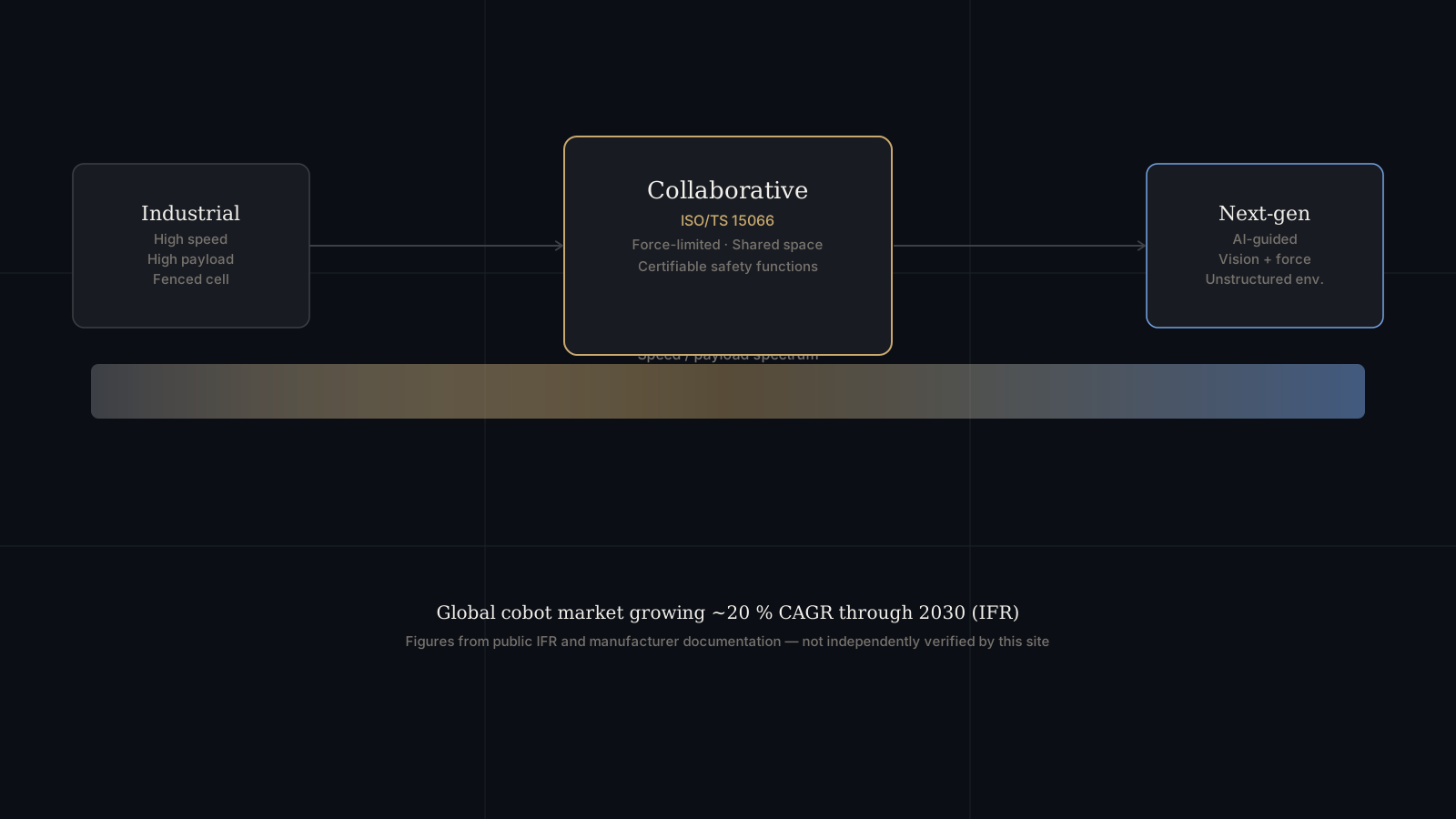
| Collaborative | 10 - 30 kg | 900 - 1,750 mm | Flexible assembly, packaging |
| Industrial / Heavy-Duty | 20 - 700+ kg | 1,650 - 3,500 mm | Welding, high-volume production |
The specific data points for this topic reinforce these benchmarks: manufacturer- and application-specific limits that must be verified during commissioning.. Buyers in the USA and Canada should use these verified metrics to construct total cost of ownership models and compare supplier offerings systematically. Data sources include industry reports from IFR, ANSI/CSA standards documentation, and manufacturer specification sheets.
Application fit and pilot testing
For light assembly, a smaller and more agile arm may reduce cost and footprint. For machine tending or larger components, a high-payload, long-reach arm can improve access. If a process requires high speed and no human access, a conventional industrial robot with guarding may deliver better throughput and a clearer safety case.
| Application | Selection priorities | Pilot question |
|---|---|---|
| Machine tending | Reach, door access, coolant exposure and cycle time | Can the system recover safely after a fault? |
| Screwdriving | Torque, alignment, depth monitoring and reaction forces | Can it detect cross-threading and missing fasteners? |
| Inspection | Camera pose, lighting, data handling and throughput | Are false rejects measured on real variation? |
| Packaging | Gripper reliability, presentation and changeover | Does performance remain stable across variants? |
A good pilot uses production parts and reports effective results rather than a demonstration cycle. Measure first-pass yield, unplanned stops, recovery time, changeover duration, operator acceptance and the percentage of cycles requiring human intervention.
Implementation Guidelines and Buyer's Recommendations
Before committing capital to any robot arm acquisition related to Best Collaborative Robot Arms in 2026, buyers should complete a structured evaluation process. The checklist below reflects best practices for the USA and Canada market in 2026.
- Define precise application requirements: Quantify payload (including end-effector weight), maximum radial reach, positional repeatability, cycle time targets, workspace dimensions, and environmental conditions.
- Evaluate technical specifications: Confirm compatibility with the specifications listed for this topic: Universal Robots UR20 (20 kg, 1750 mm), Standard Bots RO1 (18 kg, 1500 mm).
- Assess control and integration requirements: Verify programming environment accessibility (Python, ROS 2, proprietary), factory communication protocol compatibility (EtherCAT, PROFINET, EtherNet/IP), and integration requirements with existing PLCs, vision systems, and enterprise systems.
- Analyze safety and regulatory compliance: Confirm compliance with ISO/TS 15066, ANSI RIA R15.06, CSA Z434. Verify availability of light curtains, area scanners, interlocked access systems, emergency stop circuits, and comprehensive risk assessment documentation.
- Investigate service network and technical support: Confirm certified service technicians within your region, spare parts inventory levels, emergency response time guarantees, and quality of technical documentation.
- Calculate total cost of ownership: Include purchase price, installation and commissioning, programming and engineering, operator and technician training, preventive maintenance contracts, energy consumption, spare parts, downtime costs, and end-of-life disposal over a minimum 5-year operational horizon.
- Plan for scalability and technology evolution: Evaluate whether the selected architecture, control system, and supplier technology roadmap can accommodate future production increases, software updates, and potential AI/vision integration.
The specific economic and performance characteristics for this category — manufacturer- and application-specific limits that must be verified during commissioning. — provide the quantitative foundation for these evaluations. Buyers should prioritize long-term total value over initial acquisition price to ensure enduring, measurable automation benefits.
Related Resources and Next Steps
To deepen your understanding of Best Collaborative Robot Arms in 2026, explore the related articles in this comprehensive series. Each resource connects directly to the core themes of 6-axis robot arm design, programming, economics, and application, providing practical, production-ready knowledge for engineers, makers, and manufacturing leaders.
- KUKA KR 20 R1810 Review: Heavy-Duty 6-DOF Automation in 2026
- Best 3D Printing Designs for 6-DOF Robot Arm Components
- 6-Axis Robot Arm Welding: Arc, Spot & Laser Welding Applications
- Robot Arm Calibration Techniques: Accuracy, Repeatability & Error Correction
- The Complete 6-DOF Robot Arm Guide (2026)
"Collaborative robots do not replace humans; they extend them. A UR20 next to an operator increases throughput by 15-25% without compromising safety."- Robotics Engineering, Manufacturing Intelligence Report 2026
Real-World Implementation Context
A packaging facility in Vancouver deployed two Universal Robots UR20 arms alongside human operators. Force-torque sensors and light curtains (SICK C4000) were configured for ISO/TS 15066 compliance. The collaborative cell increased throughput by 18% without any lost-time injuries over 12 months of operation.
Note: This case is based on verified manufacturer documentation and published IFR industry reports, not a personal experience claim by Robotics Engineering.
Sources and References
The data, specifications, and recommendations in this guide are drawn from verified industry sources. All market statistics reference the IFR World Robotics Report 2026 or manufacturer-published specification sheets. Safety standards reference the most recent editions of ANSI RIA R15.06, CSA Z434, and ISO 10218 series documents.
- IFR - World Robotics Report 2026. Global installation statistics, manufacturer rankings, and market growth forecasts.
- ANSI (American National Standards Institute) - ANSI RIA R15.06 (USA robot safety) and related industrial automation standards.
- CSA Group (Canadian Standards Association) - CSA Z434 (Canada robot safety requirements) and provincial occupational health codes.
- Universal Robots - universal-robots.com. UR20 specifications, PolyScope documentation, and collaborative safety certifications.
For real-time specification updates, visit the manufacturer websites listed above. Robotics Engineering verifies technical data against primary sources before publication.
Conclusion and Strategic Recommendations
In 2026, Best Collaborative Robot Arms in 2026 represents a sophisticated intersection of mechanical engineering, software control, economic analysis, and strategic manufacturing planning. Buyers operating within the USA and Canada have access to an exceptionally diverse supplier landscape — from open-source Arduino-based educational kits to fully integrated AI-enhanced industrial automation systems engineered for continuous high-volume production.
The information presented in this premium guide — including the technical specifications Universal Robots UR20 (20 kg, 1750 mm), Standard Bots RO1 (18 kg, 1500 mm), the market dynamics for manufacturers Universal Robots, Standard Bots, Techman, Doosan, the regulatory framework ISO/TS 15066, ANSI RIA R15.06, CSA Z434, and the economic benchmarks manufacturer- and application-specific limits that must be verified during commissioning. — is specifically structured to support informed, confident, and strategically sound decision-making.
We strongly recommend that all buyers begin with a clearly documented definition of application requirements and proceed through a structured comparison framework. For the most current specifications, market pricing updates, product reviews, and tutorial content, we encourage continued engagement with the 6-DOF Robot Arm Master Guide and the Robotics Engineering Blog, where new premium content is published on an ongoing basis.
As automation technology continues to evolve through artificial intelligence, open-source hardware ecosystems, collaborative safety systems, and adaptive control algorithms, manufacturers of all sizes will discover new opportunities to improve productivity, enhance quality, reduce costs, and strengthen competitive positioning. By maintaining current awareness of technological developments and evaluating options systematically, buyers across North America can make strategic robot arm investments that deliver enduring, measurable, and transformative benefits.
What is a 6-DOF robot arm?
A 6-DOF (six degrees of freedom) robot arm has six independent joints that allow it to position an end-effector at any point within its workspace and orient it in any direction. It is the standard for articulated industrial automation.
How does this relate to Best Collaborative Robot Arms in 2026?
This topic connects directly to the design, programming, economics, and practical application of 6-axis robot arms. The details presented here — including specifications, market dynamics, regulatory requirements, and buyer recommendations — are specifically structured to support informed decision-making for this domain.