The Engineering Threat of Particulate Ingress
In environments like foundries, woodworking shops, and automotive machining cells, airborne particulates are a primary cause of premature robot failure. Dust impacts 6-DOF robot arms in two distinct ways. First, abrasive dust (like silica or cast iron particles) acts as a grinding compound when it infiltrates harmonic drives and joint bearings, rapidly degrading positional repeatability. Second, conductive dust (like carbon or metal shavings) can bridge traces on servo drive circuitry, causing catastrophic short circuits.
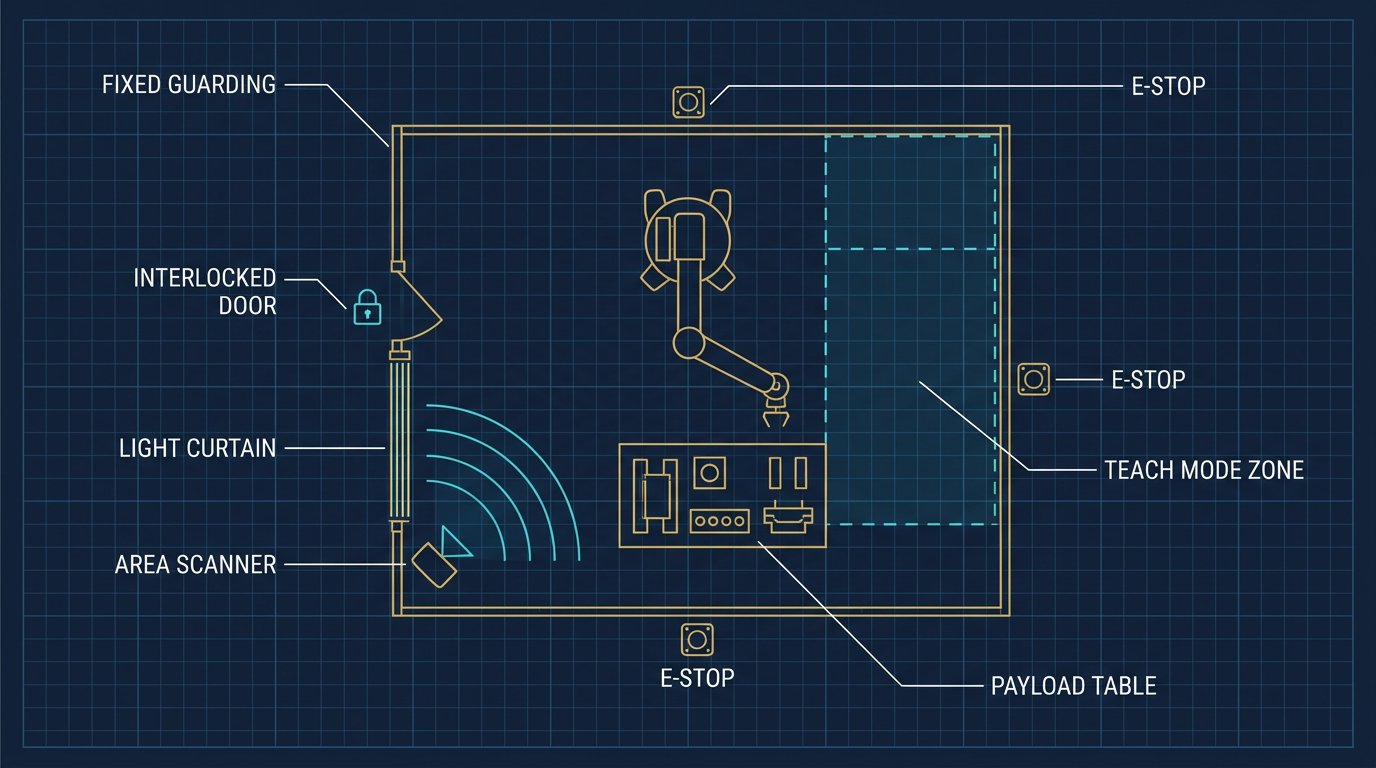
Protecting a robot arm requires a multi-layered approach: specifying the correct Ingress Protection (IP) rating, applying mechanical seals at the joint interfaces, covering exposed linear or telescoping sections, and in extreme cases, pressurizing the arm's internal cavities.
A robot's published payload capacity is meaningless if its harmonic drive is acting as a dust collector. Environmental sealing is a structural requirement, not an accessory.- Robotics Engineering, Mechanical Systems Division
Decoding IP Ratings for Industrial Robots (IEC 60529)
The baseline metric for dust protection is the IP (Ingress Protection) rating, defined by IEC 60529. The first digit indicates solid particle protection; the second indicates liquid protection. For dust-heavy applications, engineers must focus primarily on the first digit.
| IP Rating | Solid/Dust Protection | Liquid Protection | Typical Industrial Application |
|---|---|---|---|
| IP54 | Dust-Protected (limited ingress permitted, no harmful deposits) | Splashing water | General manufacturing, assembly cells |
| IP65 | Dust-Tight (zero dust ingress) | Low-pressure water jets | Machining cells, foundries, food handling |
| IP67 | Dust-Tight (zero dust ingress) | Temporary immersion (up to 1m) | Washdown environments, heavy castings |
The distinction between IP54 and IP65 is critical. An IP54 rating allows up to 5 mg/m³ of dust ingress, provided it does not interfere with operation. In a foundry, this allowable ingress will quickly accumulate inside a joint over months of continuous operation. An IP65 rating is entirely dust-tight, allowing 0 mg/m³ ingress. For highly abrasive or conductive environments, IP65 should be the minimum specification.
Mechanical Sealing Strategies for 6-Axis Joints
Achieving a high IP rating on a rotating joint is mechanically complex. The robot's axis of rotation must remain frictionless while blocking micrometer-scale particles. Engineers use several overlapping strategies.
Lip Seals and Labyrinth Seals
The primary defense at the motor output shaft is a radial shaft seal, or lip seal. These are typically made of Nitrile (Buna-N) or Fluoroelastomer (Viton) for chemical and thermal resistance. However, lip seals wear over time and create friction. For heavy-duty applications, engineers use labyrinth seals—complex geometric gaps that make it physically difficult for dust to navigate into the bearing, often combined with a final lip seal.
Bellows and Telescopic Way Covers
While sealed bearings protect internal mechanics, exposed linkages and linear rails require external covers. Fabric or polyurethane bellows (often supplied by manufacturers like Schunk or dynamic sealing specialists) accordion as the joint moves. These covers prevent grinding swarf and dust from settling into the joint interfaces. The trade-off is that bellows add parasitic friction and can slightly reduce the maximum payload or speed of the arm.
Positive Air Pressure (Purging) Systems
For the highest level of protection, especially in environments with fine, pervasive dust (like carbon black manufacturing or flour milling), mechanical seals alone are insufficient. The solution is positive air pressure, also known as purging.
Filtered, dry compressed air is plumbed into the base of the robot and routed internally into the joint cavities. By maintaining an internal pressure of approximately 0.5 bar above the ambient atmosphere, any microscopic leaks in the robot's seals will result in air bleeding out of the arm, making it physically impossible for dust to be drawn in. This requires a continuous supply of clean plant air and pneumatic regulation hardware from suppliers like SMC or Festo. The air filters for these systems typically require replacement every 6 months, depending on ambient air quality.
Specialized Environments: Cleanrooms vs. Foundries
Dust protection works both ways. In a foundry, the goal is to keep the environment out of the robot. In an ISO 14644 cleanroom (pharmaceutical or semiconductor manufacturing), the goal is to keep the robot's generated dust out of the environment.
Cleanroom robots require specialized lubricants that do not outgas, and sealed covers that trap any particulates generated by the internal gears. A foundry robot prioritizes thick external armor and purging; a cleanroom robot prioritizes sealed gearboxes and low-particulate surface finishes. Specifying the wrong type of protection will result in immediate process failure.
Implementation Checklist for Harsh Environments
- Conduct a Particulate Audit: Identify the size, abrasiveness, and conductivity of the dust in the cell. IP54 is acceptable for non-abrasive, non-conductive powders; IP65 is mandatory for metal dust.
- Specify Sealed Bearings: Ensure the robot uses 2RS (rubber sealed) or metal-shielded bearings at critical joint interfaces, not open bearings.
- Route Pneumatics for Purging: If using positive pressure, ensure clean, dry air is available at the cell. Moisture in the purge air will rust internal components faster than dust would.
- Plan Bellows Maintenance: Fabric bellows degrade from UV light, chemical splashes, and mechanical fatigue. Add them to the preventive maintenance schedule for inspection and replacement.
- Verify Cable Dress Routing: Ensure internal cable routing does not chafe against bellows or seal interfaces, which could create an ingress path over time.
Related Resources
- Cooling Systems for High-Payload 6-Axis Robot Arms: Thermal Management
- Robot Arm Cable Management: Internal Routing, Slip Rings & Sleeves
- Gripper Design Guide for 6-DOF Robot Arms: Vacuum, Magnetic & Mechanical
- Robot Arm Calibration: Accuracy, Repeatability & Error Correction
- The Complete 6-DOF Robot Arm Guide (2026)
Sources and Methodology
Technical parameters in this guide (IP54 5 mg/m³ limits, IP65 dust-tight definitions, 0.5 bar purge pressure metrics) are drawn from the IEC 60529 standard for ingress protection and ISO 14644 for cleanroom classifications. Supplier references (SMC, Festo, Schunk) reflect standard industrial practices for pneumatic purging and dynamic sealing. Always validate seal material compatibility (Viton vs. Nitrile) against the specific chemicals present in your manufacturing environment.
What is the difference between IP54 and IP65 for robot arms?
IP54 indicates 'dust protected', meaning limited dust ingress is permitted but it cannot interfere with operation. IP65 indicates 'dust tight', meaning zero dust ingress is allowed, and it also offers protection against low-pressure water jets. IP65 is required for highly abrasive or conductive dust environments.
How does positive air pressure protect a robot from dust?
Positive air pressure (purging) involves pumping clean, filtered compressed air into the robot's mechanical cavities or control cabinets. By maintaining an internal pressure of roughly 0.5 bar above ambient, air constantly leaks out through small gaps, preventing abrasive external dust from being sucked into the joints or motors during thermal cycling.
Can I add protective covers to a standard IP54 robot arm?
Yes. Third-party manufacturers supply custom bellows, telescopic way covers, and silicone jackets that can upgrade a standard IP54 robot to withstand harsh environments. However, engineers must account for the added friction, weight, and thermal insulation of these covers, which may require a slight payload reduction or enhanced motor cooling.