Palletizing — stacking cases, bags or totes onto a pallet in a defined pattern — is one of the most repetitive, injury-prone tasks on a production floor, which makes it one of the highest-return places to automate. It is also an application where the wrong robot choice is easy to make: buyers frequently compare “robot price” without accounting for tooling, guarding and integration, or size payload from a nominal case weight without including the gripper.
This guide explains how robotic palletizing systems are structured, how to size one correctly, and the safety and buying considerations that separate a working cell from an expensive mistake.
Quick verdict: who should automate palletizing first
Palletizing is a strong first automation project when the task is repetitive, the case or bag geometry is reasonably consistent, and labor turnover or injury rates on the line are high. It is a weaker first project when SKU variety is extreme, case weights are highly irregular, or floor space genuinely cannot accommodate a pallet-exchange zone.
Types of palletizing systems
| System type | Typical payload | Typical rate | Fencing | Best for |
|---|---|---|---|---|
| Cobot palletizer | ~10–30 kg | ~4–12 cases/min | Often none, per risk assessment | Low–mid volume, mixed SKU, limited floor space |
| 4-axis industrial palletizer | ~50–300+ kg | ~20–100+ cases/min | Required | Dedicated single-line, high-volume stacking |
| 6-axis industrial arm | ~50–800+ kg | ~20–100+ cases/min | Required | Irregular orientations, mixed layers, tight infeed |
| Cartesian / gantry palletizer | Heavy | Medium–high | Required | Multiple pallet lanes, very large working volume |
| Layer-forming palletizer | Full layer | ~40–120 cases/min | Required | Very high-speed single-SKU lines, less pattern flexibility |
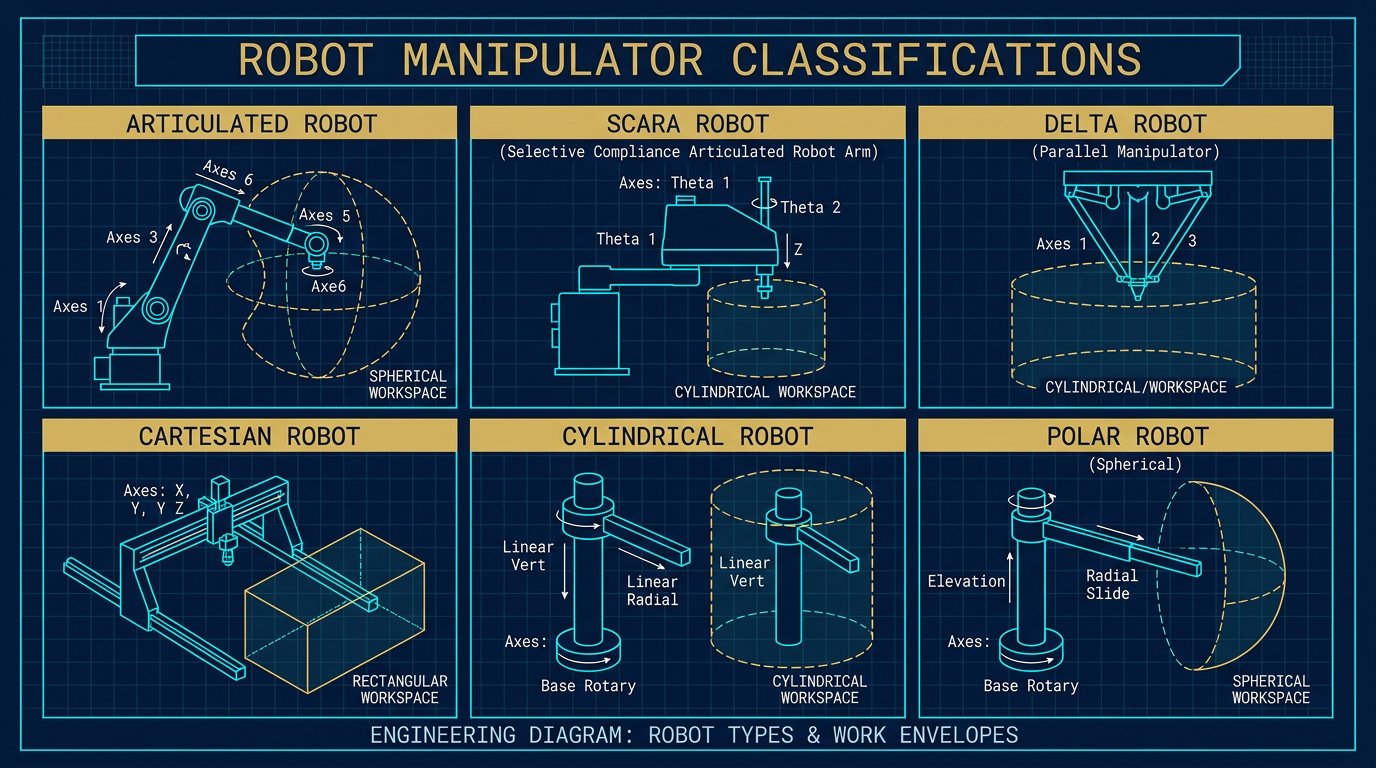
A 4-axis robot is purpose-built for the largely rotational, top-down stacking motion palletizing requires, which means fewer servo axes and generally lower cost than a 6-axis arm rated for the same payload. A 6-axis arm earns its higher price when the wrist needs to tilt bags into place, handle mixed-SKU layers, or reach into a tight infeed geometry a 4-axis structure cannot approach. For the broader kinematic comparison, see our guide to types of robotic arms.
Sizing payload and reach
Undersizing payload leads to dropped cases and nuisance faults; oversizing wastes capital. The calculation is straightforward but frequently done wrong because the gripper weight is left out.
Worked example: a 15 kg case handled by an 8 kg vacuum gripper needs at least (15 + 8) × 1.2 ≈ 27.6 kg of rated robot payload — not 15 kg. Multi-pick tooling that lifts two or more cases per cycle multiplies the load accordingly.
Reach must cover the full path from the infeed pick point to the far corner of the pallet at maximum stack height, including approach clearances. Many standard applications call for roughly 2,000–2,500 mm of reach on a GMA 48×40 in or Euro 1200×800 mm pallet footprint stacked to typical case-goods height.
Our payload calculator and ROI calculator both apply directly to a palletizing project — payload sizing feeds the robot shortlist, and the ROI tool turns that shortlist into a payback estimate.
Step-by-step: size a palletizing robot payload
- Record the maximum case/bag weight you will run (not the average).
- Add the EOAT weight (vacuum manifold, cups, frame, valves, sensors).
- Multiply by a safety margin ≈ 1.2 to account for dynamics and wear.
- If you pick multiples per cycle, multiply by the number of items lifted.
- Cross-check against the robot’s derated payload vs. reach curve if available.
How pallet patterns work
Palletizing software calculates a pattern — the arrangement of cases within a layer and the rotation applied between successive layers — before the robot ever moves. Interlocking patterns are standard practice because identically oriented layers have poor lateral stability and can shift in transit. Most commercial palletizing software lets an operator input case dimensions, pallet size and target stack height, then generates the pattern and the robot's path automatically, including collision checks as the stack grows.
End-of-arm tooling for palletizing
Vacuum grippers are the default for sealed cartons and many bagged goods because they need no side clamping, which helps when cases are packed tightly. Mechanical clamp grippers suit irregular or unsealed loads that vacuum cannot seal against. Slip-sheet and layer-pad tooling support bagged or loose product between layers. For underlying selection criteria and force calculations, see our gripper design guide and vacuum gripper sizing guide.
Safety and ISO 10218-2
A palletizing cell is evaluated as a complete system, not just a robot: the arm, the EOAT, the infeed conveyor, the pallet-exchange zone and the surrounding guarding all factor into the risk assessment. ISO 10218‑2 governs industrial robot applications and cell-level requirements, and it is the reference point for deciding whether a cobot palletizer can safely run without full perimeter fencing in a given layout. Power‑and‑force limiting reduces risk at the robot, but pinch points at the pallet‑exchange gate or a fast-moving infeed conveyor can still require light curtains, area scanners or interlocked guarding regardless of the robot's collaborative rating. See our risk assessment guide and light curtain integration guide.
Cost and throughput expectations
A complete palletizing cell budget includes the robot, EOAT, safety devices, integration and commissioning labor, and pattern-programming software — comparing bare robot price across quotes is comparing incomplete numbers. Throughput scales with system class: cobot cells commonly run in the range of roughly 4–12 cases per minute, while dedicated industrial palletizers can reach 20–100 or more cases per minute depending on payload, reach and pattern complexity.
For a full cost breakdown methodology and payback modeling, use our ROI and TCO calculator and see lease vs. buy considerations if financing is part of the decision.
Common mistakes to avoid
- Ignoring EOAT weight in payload sizing (and multi-pick multiplication).
- Underestimating reach to the far pallet corner at max height.
- Assuming cobot = no fencing without a documented risk assessment.
- Comparing robot-only prices instead of full cell quotes (tooling, guarding, software, integration).
- Skipping operator UX in pattern software when frequent changeovers are required.
Buying checklist
- Confirm required payload including EOAT weight and a safety margin, not the case weight alone.
- Map reach against the actual infeed-to-pallet-corner distance at maximum stack height.
- Decide 4-axis vs. 6-axis based on whether layers need mixed orientation or tilt.
- Get a documented risk assessment before assuming a cobot can skip fencing.
- Itemize the quote: robot, EOAT, guarding, software, integration and training as separate line items.
- Confirm pattern-software usability for changeover if you run more than one SKU.
Frequently asked questions
How much payload do I need for a palletizing robot?
Add the heaviest case or bag weight to the gripper weight, then apply roughly a 20 percent safety margin. Multi-pick tooling multiplies the requirement accordingly.
4-axis or 6-axis robot for palletizing?
4-axis robots are purpose-built for stacking motion and typically cost less. 6-axis arms add wrist flexibility for irregular orientations, mixed-SKU layers or tight infeed geometry.
Do palletizing cobots need safety fencing?
Not always — but only a documented ISO 10218-2 risk assessment can confirm that, and pinch points at the pallet-exchange zone or infeed conveyor can still require guarding.
What throughput can a robotic palletizer achieve?
Roughly 4–12 cases per minute for cobot cells, and 20–100 or more cases per minute for industrial high-speed palletizers, depending on payload, reach and pattern complexity.
How do I calculate reach for palletizing?
Measure the distance from the infeed pick location to the far pallet corner at your maximum stack height, including approach clearances and slip-sheet picks.
Which pallet sizes should I support?
Common sizes include GMA 48×40 in (North America) and Euro 1200×800 mm or 1200×1000 mm (Europe). Verify dimensions and pattern fit for each SKU.
Glossary
- EOAT: End-of-Arm Tooling — the gripper or tool attached to the robot flange.
- Interlocking pattern: Alternating layer orientations to increase stack stability.
- CPM: Cases per minute — a standard throughput metric.
- Slip-sheet: Thin sheet placed between layers to improve stability.
Continue reading: the 6-DOF Robot Arm Master Guide
Review robot architecture, programming, calibration and application fundamentals.
Read the full guide →About the author
Robotics Engineering publishes practical, vendor-neutral guidance on robot arms, ROS 2 and industrial automation. This article is maintained by our editorial engineering team and updated as standards and best practices evolve.