Why the "Best" Language Depends on the Job
Ask ten robotics engineers which programming language is best for a 6-axis robot arm, and you'll likely get ten different answers — and all of them could be correct, depending on the task. A research team building a novel bin-picking algorithm has completely different needs than a maintenance technician troubleshooting a stalled ABB welding cell on a Tuesday night shift. This guide breaks down the six programming environments you're most likely to encounter when working with 6-DOF robot arms in North America: Python (typically through ROS 2), C++, IEC 61131-3 Structured Text, and the three dominant proprietary vendor languages — RAPID (ABB), KRL (KUKA), and TP (FANUC).
Rather than declaring a single winner, this guide explains what each language is actually good at, shows real code syntax for each, and gives you a framework for choosing the right tool for your specific project — whether that's a university research lab, a startup building a custom arm, or a Tier 1 automotive supplier running FANUC welding cells.
Python with ROS 2: Rapid Development and Prototyping
Python has become the default entry point for robot arm programming in research, education, and rapid prototyping contexts, largely because of its tight integration with ROS 2 (Robot Operating System 2). Using the rclpy client library, developers can write nodes that publish joint commands, subscribe to sensor data, and call motion planning services from MoveIt 2 with relatively little boilerplate code compared to C++.
Python's main strength is iteration speed: a developer can test a new grasp planning strategy, adjust a computer vision pipeline, or reconfigure a state machine in minutes rather than hours, since there's no compilation step and the interactive nature of the language supports fast debugging. This makes it the natural choice for research, AI/vision integration (as covered in our vision systems guide), and early-stage prototyping of custom robot arm behaviors.
The tradeoff is runtime performance. Python's interpreted execution and Global Interpreter Lock (GIL) make it unsuitable for hard real-time control loops running at kilohertz frequencies — tasks like low-level joint torque control or high-speed trajectory interpolation are typically handled by C++ nodes underneath, with Python orchestrating at a higher level.
C++: Real-Time Control and Performance-Critical Code
C++ is the language underneath most of ROS 2's core infrastructure, including the DDS (Data Distribution Service) middleware that handles inter-node communication, and it remains the standard choice for writing hardware drivers, real-time controllers, and performance-critical motion planning code.
C++'s manual memory management and compiled execution give it deterministic, predictable timing behavior that's essential when a control loop needs to run reliably at 500 Hz or 1 kHz without unpredictable garbage collection pauses. Most production-grade ROS-Industrial drivers, real-time trajectory interpolators, and safety-critical control code are written in C++ for exactly this reason. The tradeoff is development speed: writing and debugging C++ typically takes longer than equivalent Python code, and memory management errors (dangling pointers, buffer overruns) can introduce hard-to-diagnose bugs.
Structured Text (IEC 61131-3): The PLC Integration Layer
Structured Text is one of the five programming languages defined in the IEC 61131-3 standard for programmable logic controllers (PLCs), and it plays a specific, often misunderstood role in robot arm systems: it typically programs the cell controller — the PLC coordinating conveyors, safety interlocks, part sensors, and I/O signals — rather than the robot's own joint motion program in most conventional setups.
Its syntax resembles Pascal, with clear IF/THEN/ELSE structures and strongly typed variables, which makes it readable for electrical engineers and controls technicians who may not have a software development background. For a robot arm integrator, fluency in Structured Text is essential — not to program the robot's path, but to correctly interface the robot's digital I/O signals with the surrounding automation cell, a skill covered in more depth in our PLC integration guide. Some modern robot controllers, including certain ABB and Stäubli platforms, also support IEC 61131-3 languages directly for select cell-level logic.
RAPID: ABB's Native Robot Language
RAPID is ABB's proprietary, purpose-built language for programming their IRB series robots through the RobotStudio environment (discussed in our simulation software guide) or directly via the FlexPendant teach device. It uses a Pascal-like syntax with robot-specific data types built directly into the language, such as robtarget for Cartesian positions and jointtarget for joint-space positions.
Note the built-in motion instructions like MoveJ (joint move) and MoveL (linear move) with explicit speed (v500 = 500 mm/s) and zone (z10 = 10 mm blend radius) parameters — these are first-class language features, not library function calls, which reflects RAPID's design purpose as a language built specifically for motion sequencing rather than general-purpose computing.
KRL: KUKA Robot Language
KRL (KUKA Robot Language) shares conceptual DNA with RAPID but uses distinctly different syntax, resembling a mix of Pascal and Basic. It runs on KUKA's KR C4/KR C5 controllers and is typically written using KUKA.WorkVisual for offline development or directly on the smartPAD teach pendant.
KRL's PTP (point-to-point) and LIN (linear) commands parallel RAPID's MoveJ and MoveL, and the $OUT[] array syntax for digital outputs reflects KRL's more hardware-register-oriented style compared to RAPID's named signal approach. Technicians moving between ABB and KUKA cells often note that the underlying concepts transfer readily, but the syntax differences mean code cannot simply be copy-pasted between the two platforms.
TP: FANUC Teach Pendant Programming
FANUC's TP (Teach Pendant) language is distinct from RAPID and KRL in that it was originally designed to be written and edited primarily on the physical teach pendant itself, using a numbered-line, menu-driven interface rather than free-form text editing — though modern development increasingly happens through ROBOGUIDE offline simulation software.
Each line is a discrete, numbered instruction — J for joint motion, L for linear motion — with position registers (P[1], P[2]) taught by physically jogging the robot to the desired pose. This line-numbered structure, inherited from FANUC's decades-long controller lineage, makes TP programs highly readable for quick on-floor edits but less suited to the abstraction and reuse patterns common in general-purpose programming languages.
Side-by-Side Comparison Table
| Language | Typical Use | Learning Curve | Portability | Real-Time Suitability |
|---|---|---|---|---|
| Python (ROS 2) | Prototyping, AI/vision, research | Low | High (any ROS 2 robot) | Low |
| C++ (ROS 2) | Drivers, real-time control | High | High (any ROS 2 robot) | High |
| Structured Text | PLC cell logic, I/O coordination | Moderate | High (any IEC 61131-3 PLC) | Moderate |
| RAPID | ABB robot motion programs | Moderate | ABB only | High (native) |
| KRL | KUKA robot motion programs | Moderate | KUKA only | High (native) |
| FANUC TP | FANUC robot motion programs | Moderate | FANUC only | High (native) |
Bridging Worlds: ROS-Industrial and Vendor Drivers
The gap between open-source ROS 2 development and proprietary vendor languages is bridged by the ROS-Industrial initiative, which maintains and coordinates driver packages that translate ROS 2 motion commands into each manufacturer's native protocol. FANUC provides official support for ROS-Industrial integration, and both ABB and KUKA have official or actively maintained community drivers that expose their robots as standard ROS 2 hardware interfaces.
In practice, this means a research team or integrator can write a single, hardware-agnostic Python or C++ application using MoveIt 2 for motion planning, and deploy it against a FANUC, ABB, or KUKA arm by swapping the underlying driver package — without rewriting the application logic. This is increasingly the architecture of choice for facilities running mixed robot fleets, as discussed in our simulation software comparison.
"You don't need to pick one language for life. Most working robotics engineers end up fluent in at least three: Python for fast iteration, C++ where performance matters, and whatever vendor language runs the robot actually bolted to the floor."— Robotics Engineering, Manufacturing Intelligence Report 2026
How to Choose the Right Language for Your Project
- Building a custom robot arm or doing academic research? Start with Python and ROS 2 — the ecosystem, documentation, and community support (thousands of publicly available ROS packages) will accelerate development far more than the raw performance of C++ matters at this stage.
- Writing a hardware driver or a control loop that must run at guaranteed timing? Use C++, ideally within the ROS 2
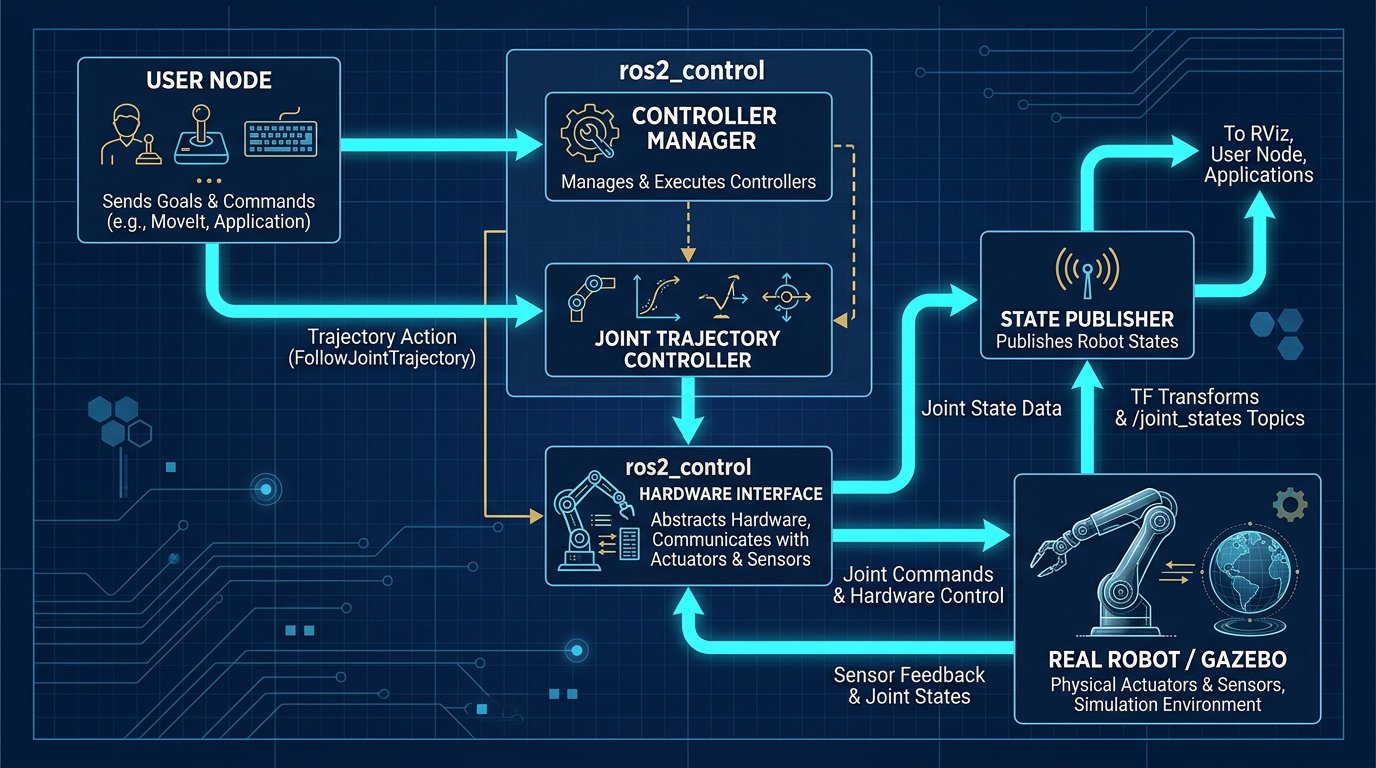
ros2_controlframework, which is specifically designed for real-time-capable hardware interfaces. - Integrating a robot cell into a larger production line with conveyors and sensors? You will need Structured Text (or another IEC 61131-3 language) regardless of which robot brand you use, since the cell-level PLC almost always speaks this language.
- Working exclusively with one robot brand in a production facility? Invest in deep fluency with that brand's native language (RAPID, KRL, or TP) — it remains the most reliable, best-documented, and best-supported way to get full access to that controller's features and diagnostics.
- Managing a mixed-brand robot fleet? Evaluate a ROS-Industrial-based architecture to unify your development workflow, while keeping at least one team member fluent in each vendor language for troubleshooting and safety configuration.
Common Mistakes When Choosing a Robot Programming Stack
- Assuming Python performance is "good enough" for everything. Teams sometimes discover late in a project that a Python-only control loop cannot meet the timing requirements of a high-speed pick-and-place application, requiring a costly rewrite of the critical path in C++.
- Ignoring Structured Text until integration day. Robotics-focused engineers sometimes underestimate how much of a real production line's logic lives in the PLC, not the robot controller, leading to painful last-minute integration work.
- Over-investing in ROS-Industrial abstraction for a single-robot, single-brand cell. If you will only ever run one FANUC robot in one fixed application, the native TP/ROBOGUIDE workflow is often simpler and better supported than building a full ROS 2 abstraction layer you don't need.
- Underestimating vendor language learning time for new hires. A team fluent in Python and ROS 2 will still need real training time to become productive in RAPID, KRL, or TP — budget for this when planning integration projects with unfamiliar robot brands.
Sources and References
Technical details and code syntax in this guide are drawn from official language and platform documentation. Readers should consult primary sources directly, as language versions and APIs are updated periodically.
- ROS 2 Documentation — official
rclpyandrclcppclient library references. - IEC 61131-3 — international standard defining PLC programming languages including Structured Text.
- ABB RobotStudio Documentation — official RAPID language reference.
- KUKA.WorkVisual Documentation — official KRL language reference.
- FANUC America — TP programming and ROS-Industrial integration documentation.
- ROS-Industrial Consortium — vendor driver compatibility and integration documentation.
Conclusion and Strategic Recommendations
There is no universal "best" language for programming 6-axis robot arms — the right choice depends on whether you're prototyping a research idea, writing a real-time hardware driver, integrating a full production cell, or maintaining a single-brand industrial installation. Python with ROS 2 offers the fastest path from idea to working demo. C++ delivers the deterministic performance that real-time control and production-grade drivers require. Structured Text remains the unavoidable language of the PLC layer coordinating everything around the robot. And the vendor languages — RAPID, KRL, and TP — remain essential for anyone working hands-on with ABB, KUKA, or FANUC hardware, respectively.
The most effective robotics engineers in 2026 don't specialize in a single language; they build fluency across this stack based on the actual demands of the project in front of them. For a broader technical foundation on the robot platforms these languages control, continue to our 6-DOF Robot Arm Master Guide.
Frequently Asked Questions
Should I learn Python or C++ for robot arm programming?
Start with Python if you are prototyping, doing research, or working with ROS 2 at a moderate pace, since it allows faster iteration and has a gentler learning curve. Learn C++ if you need to write real-time control loops, custom hardware drivers, or performance-critical nodes, since ROS 2's core communication layer and many production robotics stacks are written in C++ for lower latency and deterministic execution.
What is the difference between RAPID, KRL, and FANUC TP?
RAPID, KRL, and TP are proprietary programming languages developed by ABB, KUKA, and FANUC respectively for their own robot controllers. They share similar concepts (move instructions, coordinate frames, I/O handling) but use different syntax and are not portable between brands.
Is Structured Text (IEC 61131-3) used for robot arms?
Structured Text is primarily used to program the PLC that coordinates a robot cell's peripheral equipment (conveyors, sensors, safety relays, part feeders), not the robot's own motion program in most cases. It is essential knowledge for engineers integrating robot arms into larger automated production lines.
Can I use ROS 2 to control an industrial robot like a FANUC or ABB arm?
Yes, through vendor-maintained or community ROS 2 driver packages that translate ROS 2 motion commands into the robot's native protocol. FANUC provides official ROS-Industrial support, and ABB and KUKA have both official and community-maintained ROS 2 drivers.
Do I need to learn the robot manufacturer's own language if I already know ROS 2?
In most professional industrial environments, yes. Even when a cell is controlled through ROS 2, technicians and engineers still need to understand the underlying vendor language for tasks like teach pendant jogging, low-level diagnostics, safety configuration, and troubleshooting.
Related Resources
- Open Source Kinematic Solver Code for 6-DOF Robot Arms
- End Effector Selection Guide for 6-Axis Robot Arms: Tools, Grippers & Sensors
- Integrating 6-Axis Robot Arms with Siemens and Allen-Bradley PLCs
- Best Robot Arm Simulation Software in 2026: RobotStudio, ROS 2, Webots
- The Complete 6-DOF Robot Arm Guide (2026)