Why Preventive Maintenance Determines Robot Arm Lifespan
Unplanned robot downtime costs North American manufacturers an average of $25,000 to $50,000 per incident once you factor in lost production, emergency service calls, and expedited parts shipping. Yet most of these failures are preventable. A well-documented 2026 IFR reliability survey found that facilities running structured preventive maintenance (PM) programs experience 60-70% fewer unplanned stoppages than facilities relying on reactive, "run-to-failure" servicing.
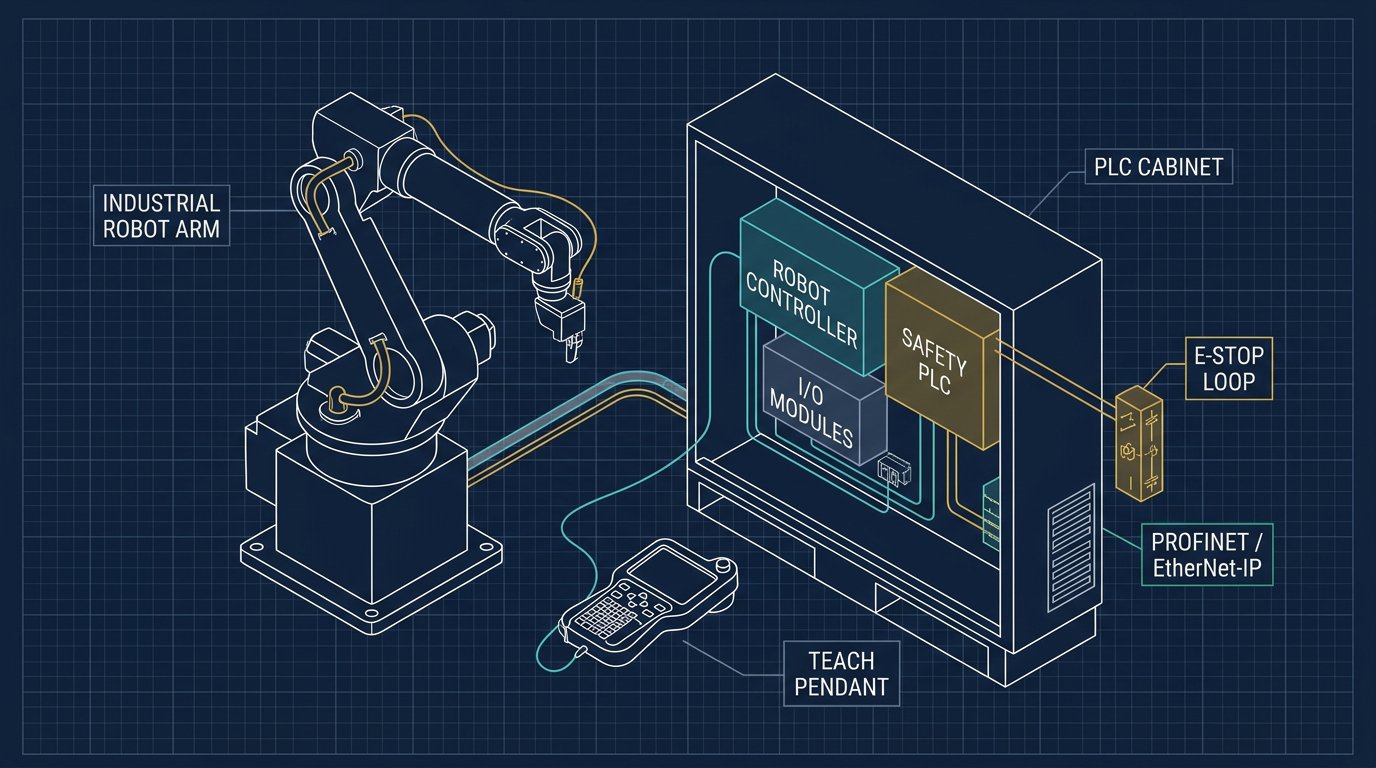
The difference is not complicated equipment — it's discipline. A 6-axis robot arm has predictable wear patterns: harmonic drives lose grease viscosity over time, encoder batteries deplete on a fixed timeline, timing belts stretch under repeated acceleration cycles, and cable bundles fatigue at flex points. Every one of these failure modes has a known interval. This guide converts that knowledge into an actionable maintenance schedule you can implement this week.
Daily Maintenance Checklist (5-10 Minutes Per Shift)
Daily checks require no tools and no robot downtime beyond a brief visual and auditory inspection during shift changeover. Assign this task to the machine operator, not just the maintenance technician — early detection depends on frequency, not expertise.
- Listen for abnormal joint noise: Grinding, clicking, or whining sounds at any of the six joints often indicate bearing wear or grease depletion before any fault code appears.
- Inspect cable management (dress pack): Check for pinching, fraying, or abrasion at flex points, particularly at joints 4-6 where wrist rotation creates the highest cyclic stress.
- Verify emergency stop and safety circuits: Test the E-stop button and confirm safety light curtains or area scanners respond correctly before production starts.
- Check air supply and pneumatic lines (if end-effector is pneumatic): Confirm pressure is within the specified 5-6 bar range with no audible leaks.
- Review the controller fault log: Even a "recovered" fault that didn't stop production is worth logging — recurring minor faults often predict a major failure within 200-500 hours.
Weekly and Monthly Maintenance Tasks
Weekly and monthly tasks require the robot to be powered down and typically take 20-45 minutes. Schedule these during planned changeovers or low-demand shifts to avoid disrupting production throughput.
Weekly (Robot Powered Off)
- Wipe down all external axes and check for grease seepage at joint seals, which can indicate a failing radial seal before it causes contamination inside the joint.
- Inspect timing belts (on robots with belt-driven axes) for visible cracking, glazing, or fraying along the tooth profile.
- Check tool center point (TCP) accuracy using a calibration pin or dial indicator against a fixed reference — drift greater than 0.1mm warrants investigation.
Monthly (Scheduled Downtime Window)
- Measure belt tension using a tension gauge and compare against the manufacturer's specification (typically 15-25 N depending on axis and belt width).
- Inspect and clean encoder connectors and battery backup units — encoder battery voltage below 3.0V should be flagged for replacement within 30 days.
- Check thermal readings on servo drives and motors using an infrared thermometer; sustained readings above 80°C at the motor housing indicate a cooling or load issue.
- Verify absolute zero-position calibration hasn't drifted by running the robot's built-in mastering check routine.
Service Interval Reference Table
The table below consolidates the most critical service intervals across major 6-axis platforms (FANUC, ABB, KUKA, Yaskawa). Always cross-reference against your specific model's service manual, as intervals can vary by ±20% depending on duty cycle and payload utilization.
| Component | Inspection Interval | Replacement / Service Interval | Failure Risk if Skipped |
|---|---|---|---|
| Harmonic drive grease | Every 2,000 h (visual) | Full regrease every 5,000-10,000 h | Backlash increase, positioning error |
| Encoder battery | Monthly voltage check | Replace every 2-3 years | Loss of absolute position, re-homing required |
| Timing belts | Monthly tension check | Replace every 15,000-20,000 h | Slippage, sudden axis stall |
| Main bearings (J1-J3) | Quarterly vibration analysis | 10-15 years typical service life | Catastrophic joint failure |
| Cable dress pack | Weekly visual | Replace every 3-5 years or 8-10M cycles | Signal loss, intermittent faults |
| Brake units | Quarterly function test | Replace per manufacturer schedule (~20,000 h) | Arm drop on power loss (safety hazard) |
| Cooling fans/filters | Monthly | Replace annually | Controller overheating, thermal shutdown |
Annual and Major Overhaul Procedures
Annual maintenance typically requires a certified technician and 1-2 days of planned downtime. This is also the point where many facilities choose between an in-house PM program and a manufacturer service contract.
- Full backlash and repeatability audit: Using a laser tracker or ballbar test, confirm the robot still meets its rated repeatability specification (typically ±0.02mm to ±0.06mm depending on model).
- Complete harmonic drive regrease: A full teardown regrease of J1-J3 harmonic drives, following the exact grease type specified by the manufacturer — mixing incompatible greases is a leading cause of premature drive failure.
- Wiring harness continuity test: Full electrical test of the dress pack and internal wiring to catch fatigue-related failures before they cause unplanned stops.
- Controller battery and capacitor inspection: Backup batteries in the control cabinet degrade over 3-5 years and should be tested under load, not just visually inspected.
- Software and firmware audit: Confirm controller firmware, safety PLC logic, and any vision/force-sensing add-ons are running supported, patched versions.
"Preventive maintenance is the cheapest insurance in manufacturing. A $2,500 spare parts inventory and a 2,000-hour inspection schedule routinely prevent $50,000 downtime events."— Robotics Engineering, Manufacturing Intelligence Report 2026
Building a Spare Parts Inventory That Actually Prevents Downtime
The biggest driver of extended downtime isn't diagnosing the problem — it's waiting for parts. A targeted spare parts inventory, typically valued between $2,000 and $3,500 per robot, dramatically reduces mean time to repair (MTTR). Prioritize stocking:
- Encoder battery packs (cheap, high failure frequency)
- Timing belts for each driven axis (moderate cost, predictable wear)
- One spare servo drive/amplifier module per robot family (highest cost, but the single biggest cause of extended downtime when unavailable)
- Brake units for J2 and J3 (safety-critical, moderate lead time from most manufacturers)
- Grease cartridges matched to OEM specification (never substitute without manufacturer approval)
In-House Maintenance vs. Manufacturer Service Contracts
Facilities running fewer than 5 robots typically find manufacturer service contracts more cost-effective than building in-house expertise, since certified technician training alone can cost $3,000-$8,000 per technician. Facilities with larger fleets (10+ robots) generally reach a break-even point where training 1-2 in-house technicians and stocking a shared spare parts inventory becomes more economical over a 3-year horizon.
| Factor | In-House Program | OEM Service Contract |
|---|---|---|
| Response time | Immediate (on-site staff) | 24-72 hours typical SLA |
| Annual cost (per robot) | $1,500-$3,000 (parts + labor) | $4,000-$9,000 (all-inclusive) |
| Technical depth | Limited to trained scope | Full OEM engineering support |
| Best fit | 10+ robot fleets | 1-5 robot facilities |
Common Maintenance Mistakes That Shorten Robot Arm Lifespan
- Over-greasing harmonic drives: Excess grease increases internal pressure and can damage seals, ironically causing the leaks technicians are trying to prevent.
- Ignoring minor recoverable faults: A fault that clears itself is still a data point. Logging and trending these often reveals a failure pattern weeks before a critical stop.
- Skipping calibration after collision events: Even a minor collision that doesn't trigger a hard fault can shift joint calibration enough to cause long-term repeatability drift.
- Using non-OEM lubricants: Grease chemistry compatibility matters — mixing lithium and non-lithium-based greases can cause the mixture to break down and lose lubricating properties entirely.
Implementation Checklist: Building Your Maintenance Program
Use this sequence to launch or formalize a preventive maintenance program for any 6-axis robot arm in your facility:
- Pull the OEM service manual for your exact model and extract the manufacturer-specified intervals as your baseline — this guide's intervals are industry averages, not model-specific specifications.
- Create a digital maintenance log (CMMS software or even a shared spreadsheet) tracking operating hours, fault codes, and completed service tasks per robot.
- Assign daily checks to operators and weekly/monthly/annual tasks to a designated maintenance technician or OEM service partner.
- Build the spare parts inventory based on the priority list above, sized to your fleet's operating hours and criticality to production.
- Review and adjust intervals quarterly based on actual fault log data — high-duty-cycle applications may need tighter intervals than the OEM baseline.
Related Resources
Continue building your 6-axis robot arm knowledge with these related guides covering hardware design, wiring, and drive systems relevant to long-term reliability.
- Arduino Mega Wiring Guide for 6-DOF Robot Arms with Smart Servos
- Aluminum Frame Design for Industrial 6-Axis Robot Arms
- Magnetic Gripper Design for 6-Axis Robot Arms: Ferrous Material Handling
- Belt Drive vs Gear Drive for 6-Axis Robot Arms: Performance & Maintenance
- The Complete 6-DOF Robot Arm Guide (2026)
Sources and References
The intervals, cost figures, and reliability data in this guide are cross-referenced against manufacturer service documentation and published industry reliability data. Always confirm final intervals against the specific service manual for your robot model and serial number, since revisions between production years can change recommended values.
- IFR (International Federation of Robotics) — World Robotics Report 2026, reliability and MTBF benchmarking data.
- FANUC America — Preventive maintenance manuals and harmonic drive service specifications.
- ISO 10218-2:2011 — Robots and robotic devices, safety requirements including maintenance-related provisions.
- CSA Z434 — Canadian industrial robot safety standard, including lockout/tagout requirements during maintenance.
Frequently Asked Questions
How often should a 6-axis robot arm be lubricated?
Harmonic drive joints typically require grease replenishment every 5,000 operating hours, while ball-screw axes may need lubrication every 2,000-3,000 hours. Always confirm exact intervals and grease type in the manufacturer's service manual, since specifications vary between FANUC, ABB, and KUKA models.
What is the average MTBF for an industrial 6-axis robot arm?
Well-maintained industrial robot arms typically achieve a Mean Time Between Failures of approximately 60,000 operating hours — roughly 6-7 years of continuous single-shift operation — provided preventive maintenance is performed every 2,000 hours as scheduled.
How much does a preventive maintenance program cost per year?
A typical annual budget ranges from $2,000 to $4,500 per robot, including a spare parts reserve of roughly $2,500, labor for scheduled inspections, and consumables such as grease, belts, and encoder batteries.
What are the warning signs of encoder failure?
Common symptoms include position drift after homing, intermittent fault codes during motion, jerky movement at specific joint angles, and loss of absolute position after a power cycle — often caused by a depleted backup battery or contamination on the optical disc.
Should I choose in-house maintenance or an OEM service contract?
Facilities with fewer than 5 robots generally find OEM service contracts more cost-effective due to high technician training costs. Fleets of 10 or more robots typically reach a break-even point where in-house maintenance, supported by a shared spare parts inventory, becomes more economical over a 3-year period.